Get Full Government Meeting Transcripts, Videos, & Alerts Forever!
Get email alerts on the Redistricting topic
No spam. Unsubscribe anytime.
Police commission unveils proposed district boundary changes; 90-day public comment period set
Summary
A consultant and the SFPD presented proposed changes to San Francisco police district boundaries to balance workload after the Southern Station move. The commission opened a 90-day public comment period and scheduled four community meetings; residents urged earlier engagement and specific boundary changes affecting the Tenderloin.
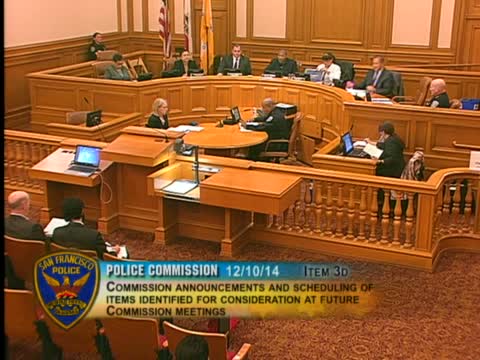
San Francisco Police Commission members on Dec. 10 heard a data-driven proposal to redraw police district boundaries after the Southern Station relocates in early 2015. The controller's office and consultant Public Safety Strategies Group presented recommended lines intended to balance incident workloads and simplify borders.
The proposal, developed over eight months, drew on CAD calls-for-service and incident ("CABLE") data, interviews with command staff and captains, and multiple map iterations reviewed by a working group and a steering committee. Randy McClure of the controller's office introduced the project; Kim Craven of Public Safety Strategies Group presented maps showing relatively small shifts for Bayview, Tenderloin, Southern, Central, Northern and Park stations. Craven said the consultant's scope focused on internal stakeholders and the data analysis; community engagement will occur now, during a 90-day period.
Vice President Turman and Chief Gregory P. emphasized that the maps are "very much in pencil" and urged public input. The commission announced four community meetings: Tenderloin on Jan. 28, Northern on Feb. 11, Southern on Feb. 25 and Bayview on March 4; locations will be posted and outreach materials will be provided in Spanish and Chinese, the commission said.
Public commenters at the meeting pushed for earlier and broader community engagement and proposed specific line changes. David Elliott Lewis, a resident and tenant advocate, said expanding the Tenderloin boundary to include both sides of Larkin Street and moving the western boundary to Van Ness could reduce a "no-man's zone" where dealers exploit split jurisdiction. Several residents urged the commission to consider enforcement implications for playgrounds and high-complaint blocks.
Commissioners asked whether the analysis accounted for underreporting in limited-English communities; Craven said demographic maps (income, youth and senior populations and other variables) were included so captains could view special populations. The chief said staffing changes would be implemented under union rules and seniority: some officers would be reassigned or temporarily loaned to stations, and Tenderloin would gain sector staffing that amounts to roughly 24 additional officers for sector cars and an overall staffing bump as full staffing returns.
The commission framed the presentation as the start of a public process, not a final decision, and asked staff to ensure outreach to language-access communities. The commission will accept written comments during the 90-day public comment window, compile them, and consider them at community meetings before any final boundary changes are forwarded for formal mapping and implementation.