Get Full Government Meeting Transcripts, Videos, & Alerts Forever!
Get email alerts on the Cleanpowersf Cca topic
No spam. Unsubscribe anytime.
SFPUC details CleanPowerSF launch plan: two products, legislative push for longer contracts
Summary
Staff presented CleanPowerSF program design and a procurement/contracting plan to launch a community choice aggregation in early 2016 with two product options (default 33–50% bundled renewables; premium 100% renewable), proposed legislation to allow longer contract terms for renewables, and an initial 30 MW launch tranche.
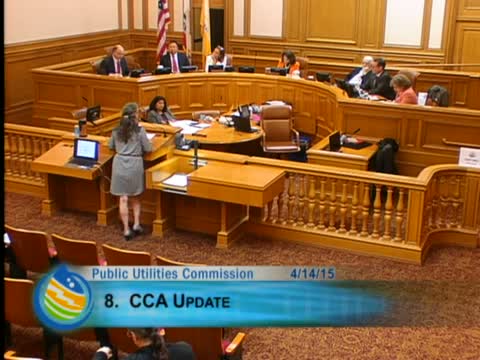
At its April 14 meeting the San Francisco Public Utilities Commission received a program design and implementation update on CleanPowerSF, the city’s planned community choice aggregation (CCA).
Barbara Hale, Assistant General Manager for Power, told commissioners the staff proposal includes two product options: a default/basic product intended to compete with PG&E’s default supply and target 33–50% bundled renewable content initially, and a premium product offering 100% renewable, greenhouse-gas-free power. The staff targets an early‑2016 launch and proposed a staged rollout starting with about 30 megawatts average load (roughly 40 MW peak) to manage early risks.
Hale outlined proposed legislative changes to streamline procurement: the SFPUC seeks authority to use certain industry-standard contracts for longer durations — up to 20 years for renewable, greenhouse‑gas‑free products and up to 10 years for other standard products — while maintaining City contracting rules for projects on City-owned property.
Staff presented not‑to‑exceed target rates shown in slides: about 8.6¢ per kWh for the default product and about 10.7¢ per kWh for the premium product; staff projected roughly $23 million in annual gross revenues for a 30 MW program and noted net revenues would vary significantly depending on premium-product participation. Hale said the premium-product revenue stream would be used to help fund local build-out (behind‑the‑meter solar, storage, demand response) over time and staff intends to pursue programs such as net-metering, feed-in tariffs and city-owned site RFPs to spur local projects.
Commissioners and public commenters asked how staff will market the premium product, how quickly the program could grow beyond the initial 30 MW tranche, and which customer segments would be included in phase 1. Multiple public commenters — including neighborhood and environmental advocates — praised the plan and urged an immediate, more detailed local build-out plan for behind‑the‑meter resources and energy-efficiency programming so revenue from the premium product funds local construction and job goals.
Staff said it will bring proposed procurement legislation to the Board of Supervisors on April 21 and will present not-to-exceed target rates to the Rate Fairness Board; final supply contracts and final rates will be presented to the Commission prior to launch if supply prices meet affordability targets.