Get Full Government Meeting Transcripts, Videos, & Alerts Forever!
Get email alerts on the Drought And Water Supply topic
No spam. Unsubscribe anytime.
SFPUC warns drought persists; keeps 10% reduction target and plans leak notifications
Summary
The San Francisco Public Utilities Commission heard a general manager update showing Hetch Hetchy at about 69% capacity, roughly 50,000 acre‑feet available to the city, and a state push for new restrictions. Staff said the city will continue a 10% water‑use reduction target and begin automated leak notifications in April.
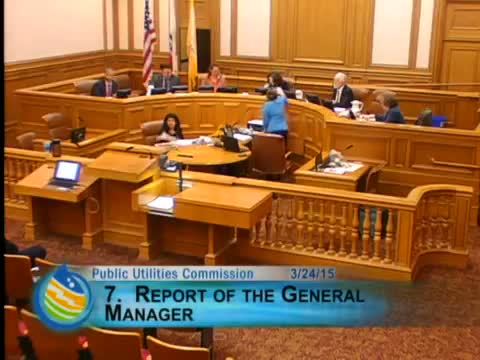
The San Francisco Public Utilities Commission on March 24 heard a detailed briefing on drought conditions and the utility’s response.
Steve Ritchie, the system official who presented the update, said Hetch Hetchy reservoir stands at roughly 69% of capacity and the Water Bank remains below about 250,000 acre‑feet. “On the water available to the city we have about 50,000 acre‑feet,” Ritchie said, adding that the Sierra Nevada snowpack is “well below where it was last year” and that the outlook will remain dry without a late‑season snow event.
Ritchie told commissioners the commission will continue its 10% conservation goal for the fiscal year — a demand cap the utility is translating into a working limit of about 209,000,000 gallons per day — and will soon launch a communications program to reinforce conservation as the region moves toward summer. “We are definitely still in a drought, a deep drought,” he said.
Staff outlined steps the commission expects to present in April to implement portions of recently extended State Water Resources Control Board emergency regulations. Those items include restrictions on landscape watering tied to measurable rain, and a new requirement that water agencies notify customers when continuous leaks are detected. Ritchie said the SFPUC plans to use its automated meter data to identify “continuous consumption” patterns and begin sending postcards notifying customers of suspected leaks starting about April 1.
On supply options, Ritchie described outreach to San Joaquin Valley irrigation districts about potential purchases; staff reported Modesto declined this year because Don Pedro reservoir levels are too low. He also described longer‑term alternatives that could be considered if the drought persists, such as desalination or potable reuse of wastewater, but said those would be more extreme and costly than additional conservation.
Commissioners pressed staff for clarity about how much of observed savings are from San Francisco residents versus wholesale customers and whether the utility can distinguish indoor from outdoor use. Ritchie said per‑capita residential use has ranged between about 39 and 46 gallons per day in recent months — among the lowest in the state — and that only accounts with dedicated irrigation meters can be definitively separated into indoor and outdoor use. For other accounts, staff rely on rule‑of‑thumb factors.
On enforcement, commissioners heard that the utility has already sent guidance to wholesale customers and will notify retail irrigation accounts that failure to meet required reductions could result in excess‑use charges and, only for the most egregious irrigation accounts, curtailments or shutoffs.
The general manager’s update also noted the release of the Westside Recycled Water Project draft EIR and described staff work to assess whether recycled water and Golden Gate Park well conversions could be accelerated.
The commission did not take a formal vote on new drought regulations in this meeting; staff said a regulatory revision to implement aspects of the state water board order is expected at a meeting in April.