Get Full Government Meeting Transcripts, Videos, & Alerts Forever!
Get email alerts on the Clean Power Sf topic
No spam. Unsubscribe anytime.
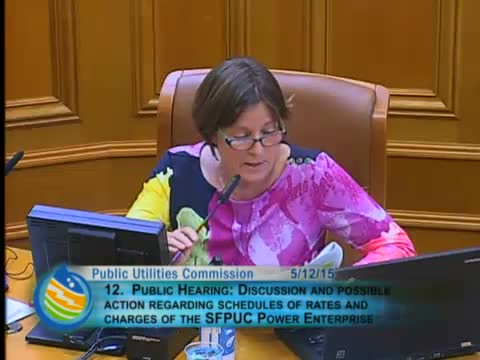
SFPUC sets not-to-exceed rates for Clean Power SF, directs further work on net metering and feed‑in tariffs
Summary
The San Francisco Public Utilities Commission on May 12 approved initial not-to-exceed rates for Clean Power SF (Community Choice Aggregation), directing staff to refine program costs, net energy metering and a feed‑in tariff before launch. The move clears a major step toward a planned January launch and passed on a voice vote.
The San Francisco Public Utilities Commission voted May 12 to set initial not-to-exceed rates for Clean Power SF, the city's Community Choice Aggregation (CCA) program, clearing a critical regulatory step toward the program's planned launch.
Charles Pearl, Interim CFO, told the commission that the not‑to‑exceed action establishes a ceiling that allows staff to proceed with procurement and program development. "This not to exceed rate approval then allows the power team to move forward with program development and renewable power procurement agreements for the planned launch, this coming January," Pearl said.
Staff described two product offerings: a default product intended to be price-competitive and to include a majority of customers at an intermediate renewable content (staff presented this as the default product), and a premium opt‑up product that would offer 100 percent renewable energy for customers willing to pay a small premium. Pearl said the opt‑up product would average approximately 2 cents more per kilowatt‑hour than the default product. He also explained that some charges assessed by PG&E — including the Power Charge Indifference Adjustment (PCIA) and a franchise fee surcharge — will be passed through on the PG&E bill, so staff set generation pricing to achieve net neutrality for the typical customer.
The resolution before the commission included three staff-directed follow-ups: prepare a proposed net energy metering schedule so on-site renewable customers receive monthly bill credits or annual true-ups; develop a proposed feed‑in tariff to encourage local renewable resources at market or incentive levels; and add language ensuring that, prior to authorizing the opt‑out process, the commission will review final costs and authorizations. "Prior to authorizing the commencement of the opt out process, this commission will review the expected cost of CCA service," Pearl read from the revised language in the resolution.
Public comments at the hearing were overwhelmingly supportive. Adele Framer, a longtime San Francisco resident, told commissioners, "Please approve the rate schedule as soon as possible and get San Francisco moving forward, towards 100% clean energy." Jason Fried, executive officer of the Local Agency Formation Commission (LAFCO), urged the commission to proceed and said he expected companion legislation at the Board of Supervisors to advance procurement authority.
Commissioners stressed the need for more detail before launch. The chair requested staff provide a business plan, marketing plan and an analysis of customer product offerings by October so the commission can judge whether the program will be competitive and commercially viable. Barbara Hale, Assistant General Manager for Power, said staff will return in the fall with procurement costs and a request for authority to commence service.
The commission approved the not‑to‑exceed rates and associated resolution on a voice vote. Staff will submit the package to the Board of Supervisors for review; if the board takes no action within 30 days the rates are deemed approved. The commission also noted the Board had passed the procurement ordinance on first reading earlier the same day.
What comes next: staff will finish power procurement work, return with a final business plan, and present recommended service rates and customer notices in the fall; the commission will review that package before authorizing the opt‑out process.