Get Full Government Meeting Transcripts, Videos, & Alerts Forever!
Get email alerts on the Clean Power topic
No spam. Unsubscribe anytime.
InterNex report says SFPUC can run "Clean Power SF" procurement but staff warns summer launch unlikely
Summary
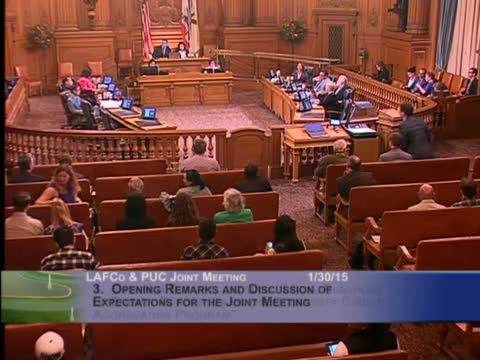
An InterNex feasibility study presented Jan. 30 concluded the San Francisco Public Utilities Commission (SFPUC) has the technical capability to procure power for a city-run Clean Power SF program, but SFPUC staff and the report’s authors said contracting, notification rules and staffing make a summer 2015 launch "not physically possible."
A consultant study presented to the San Francisco Public Utilities Commission and the Local Agency Formation Commission on Jan. 30 concluded the SFPUC can perform the power‑procurement function for a city-run community choice aggregation program known as Clean Power SF, but SFPUC staff said legal and operational constraints make an immediate summer launch infeasible.
"Yes, indeed, SFPUC through Power Enterprise does have the capability to do the power procurement on behalf of Clean Power San Francisco," Jeremy Loundergan, director of utility services consulting for InterNex, told commissioners after summarizing a review of more than 55 prior reports and recent regional data. Loundergan added a caveat: the SFPUC would likely need near‑term partnerships for 24/7 real‑time operations while building that capability in‑house.
Why it matters: the debate over Clean Power SF centers on whether San Francisco should run a default, opt‑out electricity provider offering a baseline renewable mix at rates competitive with Pacific Gas and Electric Co. (PG&E), plus an enhanced opt‑up product that would support local build‑out and jobs. Commissioner remarks and public commenters repeatedly framed the program as a major climate action and local economic opportunity — one speaker cited InterNex modeling that a 30‑megawatt local build would "remove 149 tons of CO2 a day." Those estimates will feed next steps on rate design, procurement and project selection.
SFPUC staff outlined the practical steps needed before launch. Barbara Hale, assistant general manager for SFPUC, said the report reinforced key design ideas — including a two‑tier product (a basic "light green" default priced at or near PG&E rates and a higher‑renewable "dark green" opt‑up) — but that several firm requirements limit how quickly the city can opt in customers. "It's just not physically possible" to meet a near‑term summer launch under current staffing, contracting and notification rules, Hale said, citing state opt‑out notice timelines that require mailings approximately two months before launch.
Staff emphasized parallel tracks: setting a not‑to‑exceed price ceiling tied to competitive rates, and simultaneously refining an implementation plan and business case. That approach would allow the PUC to define a default offering while developing a resource portfolio that fits within the price ceiling.
Commissioners pressed for aggressive deadlines. Several supervisors and commissioners requested a concrete timeline to return to the PUC by February with clearer dates for rate‑setting and procurement milestones; the SFPUC committed to produce scenarios and a schedule for the next commission meeting. Staff also highlighted contracting authority as a major hurdle and discussed options for private financing and bonding to accelerate build‑out — including possible use of the federal investment tax credit for projects constructed before 2017.
Public commenters — environmental groups, labor advocates and residents — overwhelmingly urged a faster launch. Speakers cited examples from Marin and Sonoma counties, which have launched CCAs and in some cases shown customer savings and local renewable procurement. Advocates pressed the SFPUC to set a not‑to‑exceed rate promptly so program design, outreach and procurement can proceed.
Next steps: LAFCO voted to accept the InterNex report for its record, and SFPUC staff said it will return with a more detailed timeline and proposed rate‑setting schedule at upcoming meetings. Any formal launch will still require compliance with state notice rules and the completion of contracting and staffing steps outlined by SFPUC staff.
(Reporting note: quotations and attributions come from the Jan. 30, 2015 joint SFPUC/LAFCO meeting transcript.)