Get Full Government Meeting Transcripts, Videos, & Alerts Forever!
Get email alerts on the Meeting Actions topic
No spam. Unsubscribe anytime.
PUC votes: minutes approved, consent items and a 10‑year LLNL water contract authorized
Summary
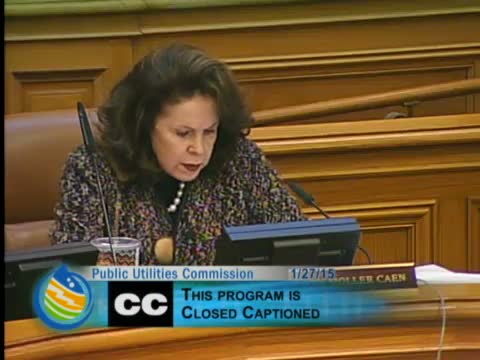
At the Jan. 27 meeting the commission approved minutes from Jan. 13, moved several consent calendar items (B–D) and authorized a new 10‑year water service contract with the U.S. Department of Energy for Lawrence Livermore National Laboratory; staff removed one consent item (9A) to the Feb. 10 agenda and the commission asserted attorney‑client privilege in closed session.
San Francisco — The San Francisco Public Utilities Commission took several procedural and contract actions at its Jan. 27 meeting.
The commission approved the minutes of Jan. 13, 2015 after a motion and second and no public comment. On the consent calendar staff requested item 9A be removed and placed on the Feb. 10 agenda; the commission approved items 9B–9D by motion (procurement and contract approvals noted on the consent list).
On item 10 the commission authorized a new 10‑year water service contract with the U.S. Department of Energy to continue water service to Lawrence Livermore National Laboratory. Staff said the federal contract includes routine provisions for alternative service and temporary cutoffs and that federal customers generally pay the same rate adjustments and are subject to conservation reductions applied to city customers.
The commission recessed into closed session to discuss existing litigation (Mountain Cascade Incorporated v. Chapman Welding Incorporated and related actions). The body voted to assert attorney‑client privilege and later, upon reconvening, moved not to disclose closed‑session details. Several scheduled closed items (14–17) were not heard.
Motions recorded at the meeting included the approval of minutes, consent calendar approvals (with one item moved to Feb. 10), authorization of the LLNL water contract and motions to assert privilege and not to disclose the closed session.