Get Full Government Meeting Transcripts, Videos, & Alerts Forever!
Get email alerts on the Biosolids Project topic
No spam. Unsubscribe anytime.
PUC outlines preferred site, technology and early cost estimates for Southeast biosolids digesters
Summary
The PUC presented a recommendation to use thermal hydrolysis pretreatment and relocate digesters at the Southeast plant adjacent to Caltrain; staff gave a baseline budget of $1.22 billion and a rough order of cost of $1.75 billion subject to refinement and said environmental review would be aggressive (aiming to complete in two years).
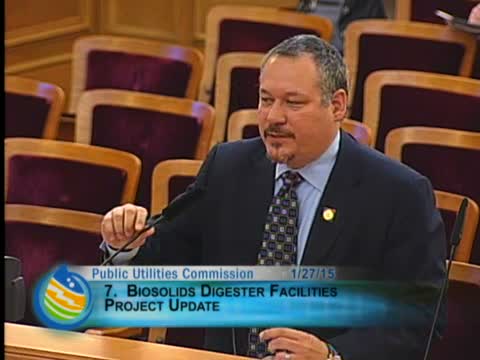
San Francisco — The San Francisco Public Utilities Commission received an informational briefing on Jan. 27 on the Southeast Plant biosolids digester project and a staff recommendation to use thermal hydrolysis pretreatment.
Emilio Cruz, assistant general manager for infrastructure, said studies are complete and staff recommends thermal hydrolysis — a high‑temperature, high‑pressure pretreatment that can produce a Class A biosolid and reduce biosolids volume by about 10 percent while expanding market reuse options. Cruz described a preferred linear layout adjacent to the Caltrain tracks that would move digesters as far as reasonably possible from nearby residences and free up land for new construction during the project.
Staff outlined site‑acquisition steps: one triangular parcel currently owned by DPW (formerly an asphalt plant) and a second parcel used by central shops; negotiations are under way to relocate central shops to a leased property in Brisbane. Cruz said the project could reduce the number of digesters from the current nine to about six (with further design potentially reducing to five) and discussed tradeoffs between burying tanks to meet a 65‑foot zoning height or seeking a height variance to reduce structural cost.
On costs and schedule, Cruz said the baseline budget was $1.22 billion, and current rough‑order costs show about $1.75 billion; staff are "scrubbing" that number and expect reductions as duplicate program components are removed and delivery methods are evaluated. The project is at approximately 2 percent design. Cruz said staff has asked City Planning to initiate environmental review, with a kickoff meeting scheduled and an aggressive goal to complete environmental documentation within two years and begin phased construction in 2017.
No action was requested at the meeting; staff emphasized continuing risk analysis and contingency planning as the project moves through conceptual design and environmental review.