Get Full Government Meeting Transcripts, Videos, & Alerts Forever!
Get email alerts on the Water Supply Drought topic
No spam. Unsubscribe anytime.
SFPUC updates: Hetch Hetchy storage steady, BOSCA flags dry‑year priorities after demand drops
Summary
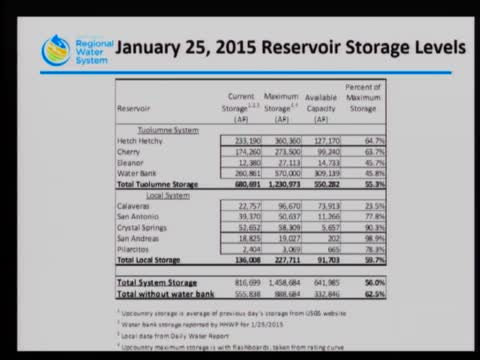
At its Jan. 27, 2015 meeting the San Francisco Public Utilities Commission heard a drought update showing Hetch Hetchy storage near 65% and a BOSCA report that projects system demand about 20% lower than earlier forecasts, prompting a shift to dry‑year planning and water‑transfer strategies.
San Francisco — The San Francisco Public Utilities Commission heard a drought update and a regional planning briefing on Jan. 27 that together shifted attention from normal‑year planning to preparing for dry‑year shortages.
Steve Ritchie, assistant general manager for water, told commissioners Hetch Hetchy reservoir storage was about 65 percent and the City’s water bank remained down roughly 45 percent but showed some recent gains from snowmelt. Ritchie said January produced essentially no precipitation at Hetch Hetchy and that snowpack is “tailing off,” stressing the city remains on a 10 percent systemwide water‑use reduction target and that officials will watch state actions closely. “If February is a dry month, I suspect that we'll see a lot of activity out of Sacramento,” he said, referring to possible curtailments by the State Water Resources Control Board.
The commission also heard results from the Bay Area regional planning body BOSCA. Nicole Stankula, BOSCA’s chief executive officer, said a long‑term reliable water supply report is complete and shows projected regional demand roughly 20 percent below prior forecasts. That change, she said, alters priorities: "We're no longer looking at normal years. We're really focused on dry years," Stankula told the commission, recommending water transfers and partnerships for storage as the highest‑priority actions and describing desalination as costly and viable only with outside partners.
BOSCA’s findings underscore planning concerns for wholesale customers and the PUC: lower consumption reduces revenues and changes reliability calculations, while dry‑year scenarios could require different investments in storage, transfers or regional partnerships. Stankula said BOSCA will roll prioritized projects and pilot water‑transfer work into its next work plan.
The PUC will continue monitoring precipitation and storage weekly and report back on actions, and commissioners returned to the drought and regional planning items during later budget and policy discussions.