Get Full Government Meeting Transcripts, Videos, & Alerts Forever!
Get email alerts on the Community Policing topic
No spam. Unsubscribe anytime.
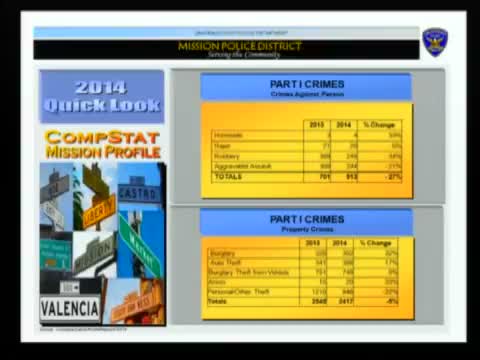
Mission Station captain highlights 27% drop in Part I crimes, stresses youth programs and partnerships
Summary
Captain Dan Perea told the San Francisco Police Commission that Mission Station saw a 27% decrease in Part I crimes year over year and emphasized youth engagement, expanded community partnerships and targeted traffic enforcement as key strategies.
Captain Dan Perea told the San Francisco Police Commission on Aug. 6 that Mission Station’s combined strategies of community engagement, traffic enforcement and specialized units have coincided with a 27% decrease in Part I crimes in the district.
Perea opened his presentation by describing the station’s footprint and resources, saying Mission Station covers about 2.3 square miles and serves more than 53,000 residents. He described station staffing as “146 members, 141 sworn and 5 non-sworn,” and listed specialized teams including station investigation sergeants, crisis-intervention trained officers, drug-recognition experts and collision-investigation personnel.
The captain placed particular emphasis on youth engagement and partnerships. “We’re now doing 7,000 summer jobs through the mayor’s office; 300 of those jobs are through the police department,” he said, and described school resource officers, officer volunteer coaching and holiday toy drives as part of a longer-term strategy to build trust with young residents. He credited neighborhood groups and nonprofits, including the Mission Education Project (MEPI) and SAFE, for supporting outreach and prevention work.
Perea also described traffic-safety work and engineering changes, including new traffic signals, as part of a broader safety push. He noted that while violent crime has fallen, property crime and auto theft remain a persistent problem and that undercover operations and traffic stops are among the tools used to address those trends.
Community partners at the meeting praised the captain’s outreach. John Sheppard of SAFE described neighborhood-watch formation as a “key part” of crime prevention, while Jean Rita Althear and other neighborhood leaders credited police visibility and community programs with making parks and streets safer.
The meeting included multiple public comments urging sustained attention to unsolved cases and continued investment in youth services. The commission praised the station’s use of social media and partnerships as contributing to the reported improvements. The commission will receive further routine reports as staffing increases with upcoming academy graduations.