Get Full Government Meeting Transcripts, Videos, & Alerts Forever!
Get email alerts on the Mental Health Policing topic
No spam. Unsubscribe anytime.
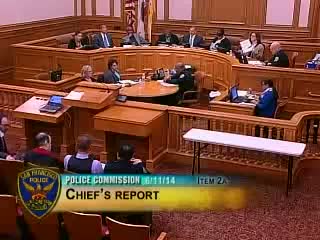
San Francisco Police Commission hears detailed update on Crisis Intervention Team training and plans for evaluation
Summary
Command staff and community partners told the Police Commission the city's 40-hour Crisis Intervention Team (CIT) program has trained roughly 269 officers (about 19% of patrol) and is moving toward dispatchable CIT responses, new CAD codes and a formal evaluation using newly collected data.
Commander Richard Correa and members of a community working group told the San Francisco Police Commission on June 11 that the department's Crisis Intervention Team (CIT) program has moved from pilot training to an operational initiative that can be dispatched to crisis calls.
Correa, who introduced the CIT update, said the program centers on a 40-hour curriculum emphasizing de-escalation, recognition of mental illness, suicide intervention and veterans'specific issues and highlighted the consumer panel as a key component for changing officer perceptions. "The Consumer Panel for the officers is something they find most interesting," Correa said, adding it "removes a whole lot of stigma." The department has recertified the course under POST and revamped the curriculum, he said.
The department has also issued a deployment bulletin (Fourteen-143) and new CAD suffixes and radio codes to identify crisis-response calls so dispatchers can send trained CIT officers directly. Correa provided early operational data showing 16,248 calls classified as 800/801/5150-type incidents last year and 28 uses of force in that set of calls, which he said represent about 2.6% of those incidents.
Training tallies presented to the commission showed 118 officers trained when the program stood up in 2012 and 269 officers trained as of this meeting, which Correa described as roughly 19% of the patrol force. The chief's target for CIT-trained officers is 20'25%; Correa said two more classes in 2014 would reach the 20% goal.
Community partners and advocacy groups who co-chair or participate in the working group said the change is cultural as much as procedural. Gifford Boyse Smith, president of NAMI San Francisco, praised "a cultural transformation" in the department and urged continued attention to service integration so police are not the default for mental-health crises. Michael Gause of the Mental Health Association and David Elliott Lewis of the Mental Health Board highlighted dispatch changes and pressed for modest funding to support site visits, catered interaction time during classes and evaluation resources.
Jesse Weller, a doctoral candidate at the Wright Institute, described a research proposal to use the new CAD suffix and CRT disposition codes to produce a quantitative evaluation comparing CIT responses and outcomes (use of force, arrests, psychiatric holds and referrals). Correa and other panelists said the new data fields make the department "data rich" and that an independent evaluation could be feasible if privacy and structure issues are resolved.
Family testimony underscored the stakes. Vinny Yang, whose sister died in an encounter with deputies in another jurisdiction, described the fatal incident and urged continued efforts to reduce lethal outcomes involving people in psychiatric crisis.
Commissioners generally praised the department's work and asked for steps to broaden exposure to CIT principles beyond the 40-hour class (for example, roll-call briefings or shorter refresher modules) and to sustain training access across watch schedules. The chief and commander said the department distributes the deployment bulletin to every officer and plans four classes per year (about 120 officers) with the potential for an additional class.
The commission did not take formal action on CIT during the meeting but directed staff to continue supporting evaluation work, consider ways to expose more officers to CIT concepts, and report back as the data project develops.