Get Full Government Meeting Transcripts, Videos, & Alerts Forever!
Get email alerts on the Water Supply topic
No spam. Unsubscribe anytime.
PUC outlines water-supply outlook and plans to comply with State's emergency water-use rules
Summary
Assistant GM Steve Ritchie reported reservoir storage and demand reductions, summarized State Water Resources Control Board emergency regulations (water-waste prohibitions and up to $500 infractions), and said the PUC will return Aug. 12 with recommendations to align mandatory outdoor-irrigation restrictions with the city's water-shortage contingency plan.
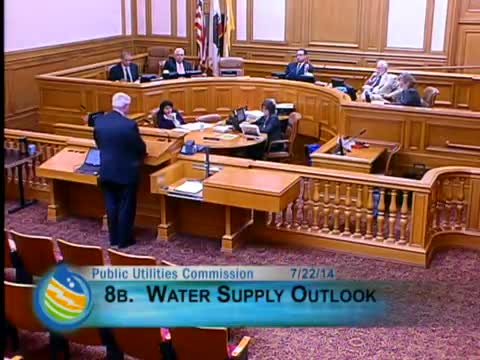
Steve Ritchie, Assistant General Manager for Water, briefed the commission on the city’s water supply outlook and new State emergency regulations adopted to curb unnecessary water use.
Ritchie reported total reservoir storage at about 63% of maximum with Hetch Hetchy about 93% full. He said recent storms produced localized precipitation gains in the Hetch Hetchy and Cherry watersheds and that customer demand has dropped sharply in recent weeks, aiding the city’s efforts to meet a cumulative savings goal of 5.7 billion gallons by Labor Day.
State regulations and enforcement: Ritchie summarized the State Water Resources Control Board’s July 15 emergency regulations, which include four water-waste prohibitions (for example, preventing irrigation that causes runoff and banning hosing of sidewalks with potable water). The rules include an enforcement provision allowing infractions of up to $500 per violation. Ritchie noted the PUC’s existing local water-efficient irrigation ordinance and said PUC staff favor education and voluntary compliance before citation enforcement.
PUC compliance plan: Ritchie said the PUC will bring a compliance recommendation to the commission at its Aug. 12 meeting to implement the mandatory outdoor-irrigation restrictions required by the State regulations as part of the city’s water-shortage contingency plan. "These regulations should go into effect about August 1 after they're approved by the Office of Administrative Law and they have a life of 270 days," Ritchie said.
Other actions: Ritchie described ongoing operational responses, including work to bring the Lower Cherry Aqueduct back into service, coordination with regional partners for emergency treated-water deliveries, and assistance to small coastal systems. He highlighted interagency transfers and arrangements being explored with neighboring districts to avoid building new treatment capacity for third-party contracts.
Next step: The commission was told to expect a specific compliance recommendation on Aug. 12 and that staff will focus on mandatory outdoor-irrigation restrictions within the water-shortage contingency plan.