Get Full Government Meeting Transcripts, Videos, & Alerts Forever!
Get email alerts on the Policing Northern Station topic
No spam. Unsubscribe anytime.
Northern Station reports drop in violent crime, outlines staffing and community plans
Summary
Captain Greg McEachern told the San Francisco Police Commission that Northern Station’s violent crime was down about 23% year‑to‑date and outlined staffing levels, crisis intervention training gains and community programs; residents urged more on-the-ground policing at the Tenderloin border and redistricting to close enforcement gaps.
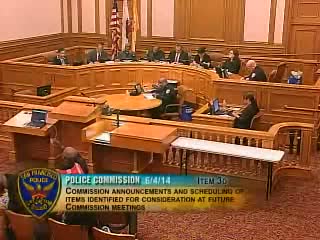
Captain Greg McEachern, Northern Station commander, told the San Francisco Police Commission at a community meeting on June 4 that Northern Station has seen a notable drop in violent crime and described staffing and community-engagement priorities.
“Currently, Northern Station is down 23% in violent crime compared to last year,” McEachern said, reporting that robberies were down about 33% and vehicle theft-related crime had declined after targeted enforcement. He said the district has roughly 139 assigned officers, of whom about 112 are currently on patrol across three watches, with specialized units including an undercover street crimes team and public‑housing officers.
McEachern described investments in training and crisis response: he said Northern Station has expanded crisis intervention training (CIT) and hoped to double the number of CIT‑trained officers within a year. He also highlighted youth and community programs that he said support crime prevention, including partnerships with Ella Hill Hutch Community Center, PAL, a backpack giveaway that distributed 2,000 backpacks, and periodic community walks to identify problem locations.
The presentation included demographic and geographic context: McEachern said Northern Station covers about 5.3 square miles, roughly 102,000 residents, and ten neighborhoods, and he identified persistent problem areas — notably Lower Polk and the Larkin Street corridor that straddles the Tenderloin border.
During public comment, several residents described continuing safety concerns at the district border. Michael Cameron, a resident who said his neighborhood abuts the Tenderloin, urged coordinated enforcement and more sustained patrols near O’Farrell and Larkin, saying parents were afraid to let children use a nearby park. Captain McEachern responded that he and neighboring captains would coordinate operations and promised to exchange contact information with community groups to plan collaborative responses.
Other public speakers offered mixed reviews. David Villalobos, who identified himself as a Lower Polk business owner, praised McEachern’s responsiveness, saying the captain “addresses our concerns” and that the increased police presence has reduced incidents in his area. By contrast, a commenter identifying as Ace delivered a forceful critique of Northern Station’s engagement with African American residents, saying the station is “appalled” and demanding more outreach and accountability.
Commissioners and the chief discussed redistricting and operational responses to border problems. The chief said the department would consider joint operations with the Tenderloin and seek input on redistricting maps to reduce jurisdictional gaps that can be exploited by dealers.
The commission closed the discussion by thanking officers for the community work described and by noting goals McEachern set for 2014, including a 5% crime reduction target for the station and continued focus on traffic‑safety enforcement and training. The meeting was adjourned in honor of two SFPD officers who died earlier that week.
The commission scheduled further follow-up and encouraged community groups concerned about specific blocks to meet with Captain McEachern and the district attorney’s neighborhood prosecutor to pursue problem‑solving strategies.