Get Full Government Meeting Transcripts, Videos, & Alerts Forever!
Get email alerts on the Traffic Safety topic
No spam. Unsubscribe anytime.
Police commission adopts 'Safe Streets for All' resolution to tighten traffic enforcement and reporting
Summary
The commission approved a resolution endorsing Vision Zero, a data-driven enforcement focus on five collision factors, monthly reporting metrics, and increased collaboration with public-health and traffic agencies to reduce injuries and fatalities on San Francisco streets.
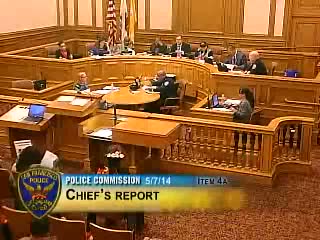
The San Francisco Police Commission voted unanimously May 7 to adopt the "Safe Streets for All" resolution, underscoring the department's commitment to Vision Zero and a data-driven approach to traffic enforcement.
Commissioner Michelle Loftus, who introduced the resolution, said the document formalizes commitments made after a citywide review of traffic fatalities and collisions. The resolution asks for monthly reporting on a set of performance metrics, including the percentage of collisions attributed to five primary factors (speeding, failure to yield, red-light violations, unsafe speed given conditions, and distracted driving), operations around schools and senior zones, and the number of citations or arrests at collision scenes.
Commander Ali presented a first-quarter traffic report showing a significant rise in citations (from roughly 22,014 in Q1 2013 to 34,097 in Q1 2014) with an overall 8.5% decline in collisions and an 18.5% drop in severe collisions. Ali said collision-reporting lag will shrink to roughly a 30-day delay to allow more timely, data-driven deployments.
Community partners including Nicole Schneider of Walk San Francisco and Leah Shay of the San Francisco Bicycle Coalition strongly supported the resolution. Schneider said that 6% of city streets account for roughly 60% of pedestrian injuries and fatalities and called the effort a public-health imperative. "This is a crisis on our hands — a preventable public-health crisis," she said.
Commissioners discussed proportionality in enforcement after data showed the largest citation increases among pedestrians and bicyclists by percentage, while most tickets remained vehicle-related in raw counts. Commander Ali and commissioners agreed to track proportions more closely and refine quarterly reports. Commissioners also highlighted a policy change committing officers to issue citations when probable cause exists, including to drivers in injury collisions when the DA declines to charge criminally.
After public comment from cycling and pedestrian advocates and brief debate, the commission approved the resolution by unanimous consent. The department said it will continue collaboration with MTA, Department of Public Health, and community partners and will provide the enhanced monthly metrics the resolution requires.