Get Full Government Meeting Transcripts, Videos, & Alerts Forever!
Get email alerts on the Pesticides Ipm topic
No spam. Unsubscribe anytime.
City staff credit Integrated Pest Management with steep pesticide cuts, flag golf as toughest challenge
Summary
Department of the Environment staff told a joint SFPUC–Environment Commission meeting that San Francisco's Integrated Pest Management (IPM) program has driven large reductions in pesticide use—but says tournament golf courses remain a significant challenge and focal point for future collaboration.
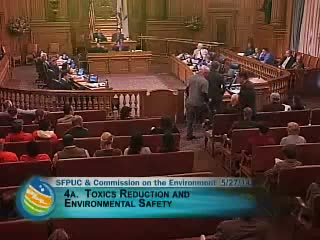
Chris Geiger, program staff in the San Francisco Department of the Environment's Toxics Reduction Program, told a joint meeting of the San Francisco Public Utilities Commission and the Commission on the Environment that the city's Integrated Pest Management program has cut most pesticide use citywide.
Geiger said the IPM program, established by ordinance in 1996 and updated in 2010, focuses on prevention and using "the best available scientific information to manage pests in a way that poses the least risk to humans and the environment." He told commissioners the city maintains a pesticide-use database, conducts annual training and requires licensed professional recommendations for pesticide applications on city property.
"We've had an 84% reduction in pesticides since the beginning of the program," Geiger said, drawing particular attention to a dramatic decline in insecticide use. He added that the program transitioned from broad chemical spraying to targeted, science‑based approaches and higher professional standards for applicators.
City staff from Recreation and Parks and Public Works described on-the-ground changes: Nikki Mixon (DPW) said the department is replacing weed-treated median strips with groundcover to reduce pesticide use and provide pollinator habitat. Kevin Wollan, a senior pest-control specialist in Recreation and Parks, described more stringent licensing requirements and increased use of biological controls, and Matt Pruitt said a new IPM plan for Harding Park has already driven operational changes.
Commissioners focused questions on measurable environmental outcomes. Commissioner Heather Stephenson asked whether reductions in pesticide application had produced detectable decreases in wastewater or drinking-water contamination; SFPUC staff said drinking water remains non-detect for the pollutants in question, but that some monitoring questions remain for wastewater effluent and stormwater runoff.
Why it matters: staff framed IPM as an interagency program that reduces public‑health risk, lowers potential contamination of water and wastewater systems, and offers a visible way the two commissions can coordinate. Commissioners and staff agreed on the need for continued data sharing and for pilot projects—particularly at golf facilities such as Harding Park—where tournament maintenance requirements create a tension between aesthetic standards and pesticide reduction goals.
The meeting closed this topic with an invitation for further collaboration between the Environment Department and SFPUC field teams on targeted monitoring and public education.