Get Full Government Meeting Transcripts, Videos, & Alerts Forever!
Get email alerts on the Rates topic
No spam. Unsubscribe anytime.
PUC lays out 4‑year water and sewer rate package; public raises affordability and program‑funding concerns
Summary
Staff and an independent consultant defended a 4‑year rate package to fund WESIP and SSIP; presentations and public testimony highlighted outreach but dozens of commenters urged stronger affordability measures and questioned use of rate revenue for policy programs.
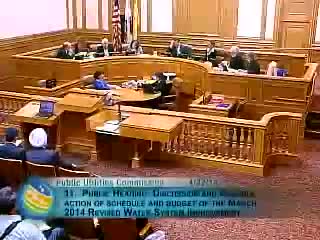
The San Francisco Public Utilities Commission on April 22 held a multi‑item public hearing on proposed retail water and wastewater rates, capacity charges and miscellaneous fees. Staff and an independent consultant presented a four‑year package of rate and structural changes they say are needed to finish the Water System Improvement Program (WESIP), begin the Sewer System Improvement Program (SSIP) and maintain long‑term system reliability.
Todd Richstrom, Assistant General Manager and CFO, and Deputy Communications Director Deborah Childers opened the hearing describing the public process: staff conducted nearly 100 community presentations that reached roughly 10,000 people in person, produced multilingual materials (English, Spanish, Chinese) and sent Proposition 218 notices to about 210,000 account holders. Childers said 92 formal protests had been received as of that morning; staff characterized that number as a small fraction of notice recipients and emphasized extensive outreach efforts.
Independent consultant Corolla Engineers (Rob Grantham) and Deputy CFO Charles Pearl outlined the cost‑of‑service study and proposed rate design. Key components include an average single‑family combined bill increase projected at about 8% next year with a roughly 38% combined increase over four years, an increase in the single‑family first tier from 3 to 4 CCF (about 748 gallons per unit) to reflect household usage patterns, inclusion of capital costs in interruptible irrigation rates (reducing the discount), a phased elimination of wastewater tiers to a single tier over four years and updates to capacity, connection and miscellaneous charges. Staff also summarized low‑income assistance programs, including the Community Assistance Program (CAP) with about 5,100 enrolled accounts.
The Rate Fairness Board reported its independent review and affirmed the staff and consultant analyses as ‘‘technically fair’’ while recommending additional work: greater transparency on the fire‑service rate methodology, a Prop 218‑compliant low‑income funding mechanism and studies on multifamily conservation signals and fairness for single‑meter multifamily buildings.
Public comment was extensive and divided. Stakeholder supporters (SPUR, Bay Area Council) praised investment in seismic reliability, water supply diversity and sewer upgrades. A coalition of neighborhood groups (Coalition for San Francisco Neighborhoods and others) voiced a detailed written resolution urging the commission to scale back ‘‘policy expenditures’’ embedded in rates, arguing such programs should be funded from the general fund or other sources; they also raised legal concerns citing precedent about the permissible scope of rate‑funded assistance. Individual residents urged better outreach to non‑English communities and stronger affordability protections for low‑income and multi‑generation households.
Commissioners asked staff to provide follow‑up materials on specific questions (e.g., the composition of the 92 formal protests, multifamily and landlord/tenant breakdowns, and comparative bills in peer cities) in advance of May 13, when action on the rate package is scheduled. No final rate action was taken on April 22; the package will return for adoption votes on May 13 and then proceed to Board of Supervisors review and, if adopted, an effective date likely of July 1.