Get Full Government Meeting Transcripts, Videos, & Alerts Forever!
Get email alerts on the Officer Involved Shootings topic
No spam. Unsubscribe anytime.
Police commission reviews third-quarter officer-involved shooting summaries; two cases received DA declinations
Summary
Sergeant John Crudo told the commission the FDRB reviewed five officer-involved discharges in the third quarter and reported that two cases (005 and 006) recently received district attorney declination letters. Commissioners pressed staff about why DA declinations can take years and noted a backlog of open OIS investigations.
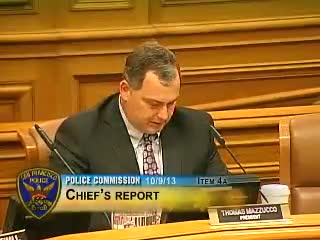
The San Francisco Police Commission on Oct. 9 heard a third-quarter summary of officer-involved shootings and related FDRB (Force Review Board) findings from Sergeant John Crudo of the department—s Internal Affairs/OIS team.
"The FDRB convened on September 19 of this year. There were five cases presented to the Board," Sergeant John Crudo said, summarizing the panel—s review of five officer-involved discharges and describing each case in brief. He said the board found several of those discharges "in policy," while one negligent discharge was determined "not in policy." Crudo reported that two cases identified as 005 and 006 recently received declination letters from the district attorney's office and said there are 17 open OIS investigations spanning from 2011 through 2013.
Commissioners pressed for detail about the time it takes the district attorney—s office to issue declination letters. Several commissioners described cases that have lingered for one to two years while awaiting the DA response. Commissioner Loftus said the delay can harm both officers and victims' families: "Two years is really difficult to understand how it would take that long," she said, noting the effect of aging evidence and witnesses.
Staff explained that three parallel processes typically run on OIS incidents—the administrative investigation, the criminal investigation, and the DA review—and that DA reviews now tend to be more thorough and include citations to legal precedent and penal code analysis. That depth, plus dependencies such as medical examiner reports and concurrent homicide inquiries, can lengthen the timeline before a formal declination or charge.
The presentation enumerated the OIS cases by reference number with short summaries (including at least one off-duty negligent discharge, several in-policy discharges involving animals or tactical responses, and one negligent negligent-discharge finding). Crudo said the cases that have received DA declinations are expected to be ready for the next FDRB.
The commission did not vote on substantive policy changes at the meeting. Commissioners asked staff to continue updates on OIS case status and to press for clearer timelines where possible.
The commission moved on to other agenda items; the OIS/FDRB presentation concluded with a request from commissioners for the department to provide more detailed status reports on long-pending cases.