Get Full Government Meeting Transcripts, Videos, & Alerts Forever!
Get email alerts on the Reserve Programs topic
No spam. Unsubscribe anytime.
SFPD captain outlines plan to grow reserve officer corps to 100 by 2015
Summary
Captain David Lazar told the commission the Reserve Officer Program would expand from 26 to 100 members by September 2015, proposing modular academies, an FTO program, increased deployment and an outreach plan that may charge tuition to break even.
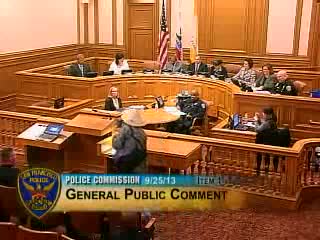
Captain David Lazar presented the Police Commission with a detailed history and a seven‑step plan to expand the San Francisco Police Department’s Reserve Officer Program.
Captain Lazar said the reserve program currently has 26 volunteers (four female, 22 male) with varied backgrounds and language skills. The department uses a three‑level training model: Level 3 (minimum 144 hours) for event and fixed‑post duties, Level 2 (minimum 333 hours) for supervised patrol, and Level 1 (minimum 664 hours) for reserves able to patrol independently. The SFPD academy itself runs about 1,130 hours for the full basic academy, nearly double the state minimum.
The captain proposed expanding the reserve corps to 100 members by Sept. 2015 through a combination of recruitment, modular academy classes run locally at the SFPD academy, a new field‑training (FTO) program for reserves, and targeted outreach (including letters to pending retirees encouraging transition to reserves). He said the department would aim to break even on modular academy tuition (preliminary estimate: roughly $2,000 per student for a 144‑hour Level 3 course) rather than operate at a loss.
Captain Lazar described current deployment (some reserves assigned to the academy, staff services, and stations; others used at special events and street fairs), monthly training requirements, and volunteer‑hour expectations (department requires 20 volunteer hours per month; POST minimums are lower). He said reserves bring wide experience — cited titles included attorney, airline pilot, firefighter, biotech researcher, and others — and spoke to benefits of retaining retiring officers as reserves to preserve institutional knowledge.
Commissioners praised the presentation and asked for follow up about costs, transitions to full‑time status for some reserves and how the program would be staffed; the captain said he would move forward with planned oral interviews, physical agility testing and background investigations for a pipeline of reserve candidates.
The commission did not vote on the reserve plan; the presentation functioned as an informational briefing and commissioners expressed general support.