Get Full Government Meeting Transcripts, Videos, & Alerts Forever!
Get email alerts on the Clean Power Sf topic
No spam. Unsubscribe anytime.
LAFCO urges 11.5¢ ceiling for Clean Power SF as commissioners and public debate rates, labor and local build‑out
Summary
At a joint SFPUC–LAFCO session on Clean Power SF, staff outlined a lowered not‑to‑exceed rate and build‑out plan. LAFCO adopted an advisory resolution recommending a 11.5¢ ceiling after extensive public comment and labor concerns; the PUC will consider final action at its afternoon meeting.
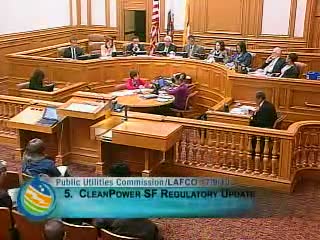
San Francisco — At a joint meeting of the San Francisco Public Utilities Commission and the Local Agency Formation Commission, officials advanced the Community Choice Aggregation program known as Clean Power SF and LAFCO adopted an advisory resolution recommending a not‑to‑exceed rate ceiling of 11.5¢ per kilowatt‑hour.
"This is not the approval of a contract with Shell," LAFCO Chair John Avalos said in opening remarks, stressing the commission was setting a price ceiling rather than approving any procurement contract. PUC staff, led by Kim Malcolm, presented a reworked program design and a rate analysis that reduced an earlier 14.57¢ estimate to a proposed ceiling of 11.9¢ and described circumstances under which an initial launch rate could be set below 11¢.
Why it matters: the not‑to‑exceed rate determines how much revenue is available for the program's local build‑out, which staff and advocates say will finance new renewable generation and local jobs. PUC staff told commissioners the program could generate initial build‑out funds of about $2–4 million per year and build to roughly $200 million in bonding capacity after about 2½ years if enrollment and finances track their scenario.
Staff presentation and numbers: Kim Malcolm, director of Clean Power SF, walked commissioners through program design choices, resource mixes and rate scenarios. "Our rates as of today, the proposed rate is 11.9¢," Malcolm said, noting some of the reductions came from market price drops and proposed purchases of RECs/REX. Todd Richterman, assistant general manager and CFO, said the Rate Fairness Board had opined earlier this year that staff should aggressively minimize costs and that the revised numbers reflect that direction.
Debate over REX/RECs and local sourcing: Commissioners pressed staff on differences with Marin and Sonoma programs, administrative costs, and the program's reliance on REX (renewable energy credits). Labor representatives and IBEW attendees urged greater emphasis on locally generated power and stronger commitments to union jobs. Hunter Stern of IBEW argued that "RECs aren't energy," and said labor will press for clearer local‑sourcing and job standards in implementation.
Public comment and equity concerns: more than two dozen members of the public spoke. Supporters highlighted climate urgency and local job creation; opponents and community advocates raised concerns about outreach and equity in San Francisco's Southeast neighborhoods. Tyrone Joo, PUC communications director, said mailers and opt‑out notices will be provided in English, Chinese and Spanish and that staff has held dozens of evening outreach events.
Motion and LAFCO action: Commissioner Viator moved to amend the resolution's 11.9¢ ceiling to 11.5¢. The amendment did not receive an immediate PUC second during the special session, but LAFCO proceeded with an advisory vote later in the joint meeting. LAFCO Commissioner Campos moved the advisory resolution recommending the 11.5¢ not‑to‑exceed rate; the motion was seconded and passed without objection by the LAFCO commission. The motion is advisory; the PUC will revisit the item at its 1:30 p.m. session.
Next steps: staff said adopting a not‑to‑exceed rate would enable the program to finalize procurement steps, continue negotiations with Shell Energy (which the Board of Supervisors previously authorized the city to negotiate with) and prepare the customer education and opt‑out notices required for a launch. Staff estimated a 6–8 month timeline to launch after the commission sets final rates and clears outstanding steps. PUC President Torres and other commissioners indicated they intend to continue meeting with labor and community stakeholders during the implementation period.
What wasn't decided: the commission clarified it was not approving any procurement contract today; the PUC did not take a final vote on the resolution in the morning session and will consider the item again at 1:30 p.m. The record contains outstanding labor requests for stronger local sourcing commitments and clearer detail on how many jobs would be created in particular neighborhoods, which staff said they will continue to discuss.
The meeting recessed and the PUC scheduled its next session at 1:30 p.m. to consider the final resolution and any amendments.