Get Full Government Meeting Transcripts, Videos, & Alerts Forever!
Get email alerts on the Flood Protection Grant topic
No spam. Unsubscribe anytime.
SFPUC authorizes $250,000 pilot to reimburse floodproofing for affected properties
Summary
The commission authorized the general manager to execute a pilot grant program to reimburse ratepayers for backflow preventers and door/garage flood barriers; staff described unit costs, eligibility criteria and mid‑/long‑term stormwater infrastructure work including an 800,000‑gallon cistern at Seventeenth & Folsom.
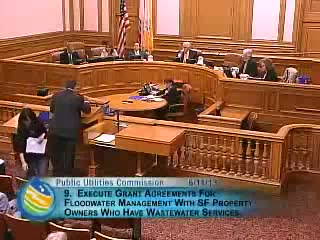
The San Francisco Public Utilities Commission voted on March 26 to authorize the general manager to execute agreements for a pilot floodwater management grant program designed to help homeowners and businesses protect properties from sewer backups and localized storm flooding.
Emilio Cruz, Assistant General Manager for Infrastructure, described a tiered approach: immediate homeowner‑level measures (backflow preventers and door/garage barriers), midterm localized storage (an 800,000‑gallon storage tank proposed under a new park at Seventeenth & Folsom) and long‑term green and grey infrastructure improvements across the 20‑year SSIP program. Cruz said the pilot would reimburse 100% of eligible costs up to a pilot fund of $250,000 and that staff expect modest initial demand concentrated in locations with a documented history of sewer backup.
Staff provided unit estimates: pedestrian flood door barriers approximately $2,500, large commercial/garage barriers about $6,000, a backflow prevention device about $2,500 and typical installation costs of $2,000–$3,000; Cruz gave a rough overall per‑household estimate near $10,000 depending on the number and size of doors. Eligibility requires that applicants demonstrate a historical flooding problem; staff said filing a claim with the city is one acceptable method but not the only way and that applications will be evaluated case‑by‑case.
Commissioners sought to preserve protections against using the grant to pay for unrelated code enforcement work. Staff said DBI (Department of Building Inspection) will review permits for backflow devices and that owners are responsible for bringing piping/drainage up to code to the property line; the PUC will reimburse costs for the backflow device and related improvements beyond that baseline. Commissioners asked staff to review and refine the guideline language before final posting; the motion was made subject to that review.
Affected business owners and residents offered location‑specific input during public comment. Hans Art, an auto mechanic with a shop near Seventeenth & Folsom, said temporary door barriers often cannot be deployed in time and suggested raising a parking lot as an alternative; staff responded that backflow preventers address sewer backups while door barriers are supplemental and that some sites may require multiple measures.
The commission approved the authorization by voice vote. Staff said that if the pilot proves broadly popular they may return to request additional funding and that the pilot is intended to demonstrate immediate mitigation while larger green infrastructure and storage projects are planned and implemented.
Ending: The pilot is authorized subject to final guideline language regarding code‑compliance; staff will accept applications, coordinate with DBI for permitting and return to the commission if additional funding or program modifications are needed.