Get Full Government Meeting Transcripts, Videos, & Alerts Forever!
Get email alerts on the Pedestrian Safety topic
No spam. Unsubscribe anytime.
SFPD outlines citywide pedestrian safety push as fatalities and staffing drive strategy
Summary
San Francisco Police Department leaders told the Police Commission the city will expand education, engineering and enforcement to reduce pedestrian injuries and fatalities, citing 8 pedestrian deaths year-to-date, data-sharing with MTA and plans for automated enforcement and new handheld citation devices.
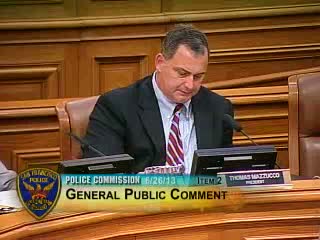
The San Francisco Police Department presented a citywide pedestrian safety strategy to the Police Commission on June 26, saying it will pair targeted enforcement with engineering and neighborhood education to reduce injuries and deaths.
Chief Gregory Pease summarized the department's approach as the three 'Es': engineering, education and enforcement. He told commissioners the department has focused operations on five primary collision factors identified in a Department of Public Health study and is sharing collision data with the Municipal Transportation Agency through a platform called Crossroads to speed up engineering remedies such as retiming signals and installing curb bulbs.
'We're trying to make sure all agencies are in sync ' so there's better coordination of education, engineering and enforcement,' Chief Pease said, describing ongoing ComStat reporting of citations by district.
Commander Mikhail Ali described enforcement tactics including plainclothes pedestrian-sting operations paired with uniformed citation teams and said the department issued more than 600 distracted-driving citations in April alone as part of national campaigns. Ali said every academy graduate now receives a basic collision-investigation certification and that the department consolidated collision work into a Traffic Collision Investigation Unit.
The department reported eight pedestrian fatalities year-to-date. Ali said the police will roll out handheld devices for citation issuance by the end of August and publish monthly citation and enforcement statistics on sfgov.org so neighborhoods can track activity and outcomes.
Commissioners pressed the chief on whether increased enforcement is feasible amid staffing shortfalls. Commissioner Loftus and others linked lower citation volumes to reduced staffing, while Chief Pease and Ali said a six-year hiring plan and restored traffic-company staffing would expand enforcement capacity.
Irina Chatsova of SAFE described neighborhood-led campaigns supported by Community Police Action Boards, including a distracted-walking warning card, a school-centered "Street Smarts" program, and a Safe Passage Tenderloin mural pilot. Chatsova said SAFE translates materials into five languages and coordinates citywide sharing of effective neighborhood tactics.
The commission requested a follow-up report on staffing and collision trends in about six months to review whether added traffic-company personnel and education campaigns produce measurable reductions in fatalities. The department said it expects to have more complete collision-reporting tools and online dashboards by January.