Get Full Government Meeting Transcripts, Videos, & Alerts Forever!
Get email alerts on the Police Operations topic
No spam. Unsubscribe anytime.
Chief highlights 10-year low in homicides, proposes camera gap analysis for large events
Summary
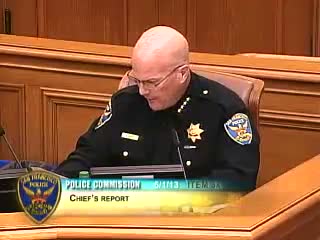
Chief reported April marked a 10-year low in homicides and outlined programs including academy classes and a sobering program; he proposed surveying public and private cameras to identify blind spots for large events, saying he would not seek a city-owned camera network.
San Francisco's police chief reported to the Police Commission on May 1 that the department closed April with a 10-year low in homicides and outlined public-safety programs and staffing efforts, while proposing a public-private camera gap analysis for major events.
The chief said the department has recorded 12 homicides year to date and credited officers and community partners for progress on deadly violence. He noted increased firearm-possession arrests, including higher counts in the Bayview, and previewed academy activity: graduates this week and a large lateral class that included officers from LAPD, San Diego, Oakland and San Jose.
On social-service strategies, the chief described a new inebriate (sobering) program modeled on San Diego: officers would make non-arrest contacts through a five-contact process and only on a sixth contact within 30 days would arrest be considered if the person refused services. The chief said the DA, sheriff and courts have been consulted as the program proceeds.
Addressing cameras for public safety and event security, a public commenter had cited a Rialto Police Department study and a New York Times article suggesting an "88% decline in the number of complaints" and a large drop in officer use-of-force when officers wore cameras. The chief told the commission he was not proposing a city-owned camera system and instead recommended a survey of existing public and private cameras in assembly areas, Market Street and Civic Center to perform a gap analysis and explore public-private partnerships for coverage during very large televised events. "I was not asking nor will I be asking for a city owned camera system," the chief said.
The chief emphasized that any real-time monitoring would be rare and limited to major events and that retrospective collection of private-camera footage via warrant or request would remain a tool in criminal investigations.
Commissioners and the chief agreed to further discussion of cameras, privacy concerns raised by civil-rights groups and the logistics of any public-private coordination for event coverage.