Get Full Government Meeting Transcripts, Videos, & Alerts Forever!
Get email alerts on the Public Safety topic
No spam. Unsubscribe anytime.
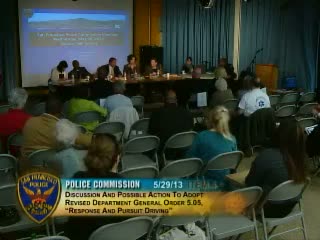
Captain Falvi outlines Ingleside crime trends and community policing at May 29 Police Commission meeting
Summary
Captain Timothy Falvi told the Police Commission that Ingleside Station is focusing on targeted enforcement, community outreach and training after data showing robberies and vehicle theft patterns; he highlighted language‑access efforts, Crisis Intervention Team training and partnerships with neighborhood groups.
Captain Timothy Falvi, commanding officer of Ingleside Station, told the San Francisco Police Commission on May 29 that his district’s strategy to reduce crime blends enforcement, education and environmental fixes.
Falvi said the Ingleside district covers about 6.5 square miles and roughly 124,000 residents and outlined staffing and patrol arrangements: 108 officers assigned to the station and 16 recruits in training. He described foot‑beat and bicycle patrols focused on transit hubs and business corridors, a plainclothes unit and eight officers dedicated to public housing properties including Alemany, Holly Court and Sunnydale.
The captain gave several data points to explain targeted operations. Through April he said robberies are up citywide and in Ingleside; 55% of the robberies in the district involved cell phones and 36% involved iPhones, and in 25% of robberies the phone was the only item taken. On auto theft, he said pre‑2001 Hondas and Acuras accounted for roughly half the vehicles stolen and explained older ignition systems made them easier to start without modern immobilizers.
"We look for trends like that," Falvi said, describing CompStat‑style daily reviews that inform where to deploy decoy operations, robbery abatement and extra plainclothes patrols. He said the station has used flyers, merchant meetings and targeted second‑half‑of‑month enforcement because 63% of recent robberies occurred in the latter half of the month.
Falvi also described traffic and pedestrian safety work: radar trailers rotated to problem corridors, motorcycle enforcement, and coordinated operations at intersections identified with the Municipal Transportation Agency. He cited two recent pedestrian fatalities and said enforcement followed within days at affected schools and crosswalks.
On training and crisis response, Falvi reported 14 Crisis Intervention Team (CIT)‑trained officers at Ingleside and planned additional CIT sessions (June 17–20) to broaden coverage across watches. He said the station is trying to increase bilingual officers through recruiting and language testing and is working with community partners and groups — including neighborhood councils, the Boys & Girls Club and Recology — on hotspot walks and youth programming.
The captain framed much of the effort as prevention: fixing lighting with Public Works, encouraging residents to secure garage‑door openers and running youth summits to build trust. "The goal at Ingleside Station is to make Ingleside' the safest one to live in, visit, or work in in all of San Francisco," he said.
Next steps cited by Falvi included continuing targeted enforcement where data show spikes, expanding CIT coverage across all watches and pursuing funding with supervisors for infrastructure fixes in public housing.