Get Full Government Meeting Transcripts, Videos, & Alerts Forever!
Get email alerts on the Clean Power Sf Rates topic
No spam. Unsubscribe anytime.
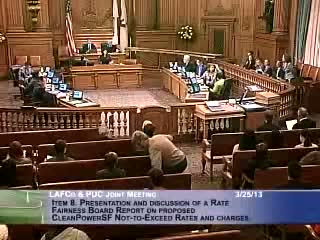
San Francisco officials cite survey support but defer Clean Power SF rate decision pending build‑out and bonding scenarios
Summary
PUC and LAFCO heard February survey results showing conditional public support for Clean Power SF; staff presented a proposed not‑to‑exceed residential generation rate of $0.1457/kWh and options to free up funds for a local build‑out. Commissioners asked for additional rate, bonding and build‑out scenarios and moved final action to a later hearing.
The San Francisco Public Utilities Commission and the Local Agency Formation Commission on the record reviewed new resident polling and the proposed not‑to‑exceed rates for Clean Power SF, and directed staff to return with more concrete build‑out and bonding scenarios before approving rates.
A consultant presented the February survey, based on 2,700 telephone interviews in English, Spanish and Chinese, finding that public awareness of Clean Power SF remained low but that support varied with price and program detail. David Metz, partner at Fairbank, Maslin, Maslin, Metz & Associates, told commissioners the numbers ranged from roughly 41 percent to 55 percent saying they would remain with Clean Power SF depending on whether respondents were given the not‑to‑exceed rate or a lower projected rate and whether a local build‑out was described.
Why it matters: the PUC needs a stable customer base and predictable revenues to finance local renewable projects and to demonstrate capacity to bond for build‑out. Commissioners said they will not approve final rates until they can see scenarios that show how different rate and resource‑mix choices affect bonding capacity and the funds available for local investment.
The staff presentation broke down the levers that can change program economics: altering the renewable product mix (more renewable energy credits versus bundled or firmed/ shaped energy), extending the period used to recover the program's start‑up reserve, and assumptions about low‑income (CARE) customer participation. Barbara Hale, assistant general manager for POWER, said changing the resource mix from a portfolio heavy on bundled firm energy to one with more renewable energy credits could free roughly $7.2 million annually; extending reserve recovery from 4.5 years to 12 years could free about $1.5 million annually.
Crispin Hollings, SFPUC director of financial planning, showed a modeled year‑one cost of service of $0.1409 per kilowatt‑hour; after the CARE (low‑income) adjustment staff proposed a not‑to‑exceed generation rate of $0.1457 per kWh for basic residential customers. Hollings said that difference yields an estimated monthly premium of about $10.24 for an average Tier‑1 residential customer compared with a 2013 PG&E generation rate of $0.0788 per kWh.
Rate fairness and feasibility: Kevin Chang, chair of the Rate Fairness Board, told the joint meeting the Phase 1 rates were "technically fair" under the board's cost‑of‑service standard but warned that the premium could limit market uptake. "The primary concern is the feasibility of the San Francisco market to sustain a premium product," Chang said, urging aggressive cost management and a plan to review rates after start‑up.
What commissioners asked for: several members requested scenario analyses that translate choices about resource mix, reserve amortization and CARE assumptions into (a) projected customer opt‑out rates, (b) annual funds available for local build‑out, and (c) estimated bonding capacity. President Torres and other commissioners requested an actionable outline or plan for local build‑out (financing, phasing, estimated jobs, and greenhouse‑gas reductions) and scheduled a follow‑up joint hearing to continue the rate discussion.
Next steps: staff agreed to bring back rate and bonding scenarios and a more concrete build‑out outline for discussion prior to the next decision. The meeting left the not‑to‑exceed rate unresolved; commissioners did not vote to adopt final rates at this session.
Sources: presentations and Q&A at the joint SFPUC–LAFCO meeting, including statements by David Metz (survey consultant), Barbara Hale (SFPUC assistant general manager for POWER), Crispin Hollings (SFPUC director of financial planning) and Kevin Chang (Rate Fairness Board chair).