Get Full Government Meeting Transcripts, Videos, & Alerts Forever!
Get email alerts on the Clean Power Sf topic
No spam. Unsubscribe anytime.
Survey finds mixed support for Clean Power SF; PUC to weigh rates, renewable mix and local build-out
Summary
A PUC-commissioned survey of nearly 3,000 ratepayers found limited awareness of Clean Power SF and varying willingness to remain in the program depending on rate scenarios and a potential PG&E alternative; commissioners asked staff for modeling, heat maps and rate/mix scenarios before a March 20 decision.
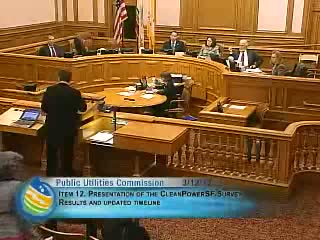
The San Francisco Public Utilities Commission heard Feb. 27 the results of a customer survey that showed limited public awareness of Clean Power SF but varying levels of support depending on how price and program details were described.
David Metz of FM3, the survey contractor, said the firm conducted nearly 3,000 telephone interviews in English, Spanish and Chinese and weighted results to match San Francisco ratepayer demographics. Baseline awareness of the program stood at about 21%.
When asked without pricing information whether they would remain in a Clean Power SF program, 45% of respondents said they would stay while 30% said they would opt out; the remainder were undecided. Once respondents were shown a "not to exceed" rate estimate for their tier, 47% said they would stay while 42% said they would opt out. Presenting a lower alternative rate increased intent to remain; when given messaging about local build-out and jobs the final survey question put support at roughly 52% staying versus 36% opting out.
Commissioners probed the meaning of "definitely" versus "probably" stay answers and asked staff and FM3 to model how undecideds and probable stayers would behave in an automatic enrollment/opt-out operational context. Jason Fried (LAFCo staff) cautioned that survey presentation can understate the number of people who would in practice remain enrolled because opting out requires affirmative paperwork; he recommended the commission consider ranges and conservative modeling when sizing initial program offerings.
Staff said the preliminary modeling and the PUC "heat map" exercise would be used to target a phased initial offering of roughly 20–30 megawatts (about 176,000 MWh), focused on basic-tier residential customers, and that staff will present visualizations and sensitivity scenarios on March 20. Commissioners and stakeholders pressed staff for scenario comparisons (e.g., $6, $8, $10 premium options) showing how different renewables mixes would affect both rates and funds available for local build-out, including GoSolar incentives.
Public commenters including Sierra Club representatives urged a stronger and earlier commitment to local investment and local jobs; other advocates warned that if the PUC's rate is significantly higher than a future PG&E green tariff the program could lose customers. Staff noted that program risks are partially mitigated by contractual arrangements with Shell and by a capped unwind exposure estimated in the packet (a capped damages exposure to Shell of $13.5 million), and that staff are building conservative assumptions into their modeling.
Next steps: staff will present heat maps, modeled opt-out forecasts and rate/mix scenarios at the March 20 joint meeting to support final decisions on not-to-exceed rates and initial phase sizing.