Get Full Government Meeting Transcripts, Videos, & Alerts Forever!
Get email alerts on the Oversight topic
No spam. Unsubscribe anytime.
Office of Citizen Complaints reports 746 complaints in 2012; mediation and standards explained
Summary
Joyce Hicks, director of the Office of Citizen Complaints, told the Police Commission the OCC received 746 complaints in 2012, sustained allegations in 60% of closed cases, mediated 62 cases and aims to complete most investigations within nine months under a preponderance‑of‑evidence standard.
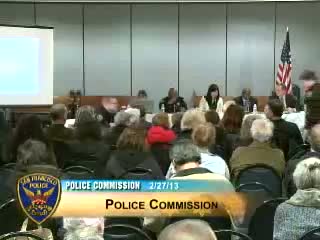
Joyce Hicks, director of the Office of Citizen Complaints (OCC), presented the OCC’s role, investigative process and 2012 caseload at the Police Commission community meeting.
Hicks said the OCC — established by a 1982 board‑of‑supervisors charter amendment and now independent of the police department — conducts investigations of civilian complaints, has subpoena authority and aims to complete investigations within nine months (with limited exceptions up to one year). She described the office’s standard of proof as a preponderance of evidence and outlined the discipline process: the chief may impose discipline up to 10 days’ suspension, while cases with potential discipline greater than 10 days go before the Police Commission.
On 2012 statistics, Hicks reported the OCC received 746 complaints (a 6% reduction from 2011) and closed 799 cases the prior year; she said 60% of allegations in closed cases were sustained, 31% found proper conduct, and 4% were unfounded. Hicks noted unwarranted action and conduct reflecting discredit were the most common allegation types and described OCC mediation efforts (62 mediations in 2012, roughly 8% of closed cases) as a voluntary alternative to discipline.
Hicks also gave operational details: OCC staff of about 33 (with two investigator vacancies), multilingual intake and outreach (Spanish, Cantonese, Burmese, Tagalog), a physical office at 25 Van Ness Avenue and a public website for filing complaints. She invited residents to consult OCC brochures and the OCC’s senior investigator, who was present at the meeting.
Hicks’s presentation explained the OCC’s investigative remit and encouraged community members to file complaints by phone, mail, fax, email or in person so the OSC can follow evidence and recommend policy or disciplinary outcomes.