Get Full Government Meeting Transcripts, Videos, & Alerts Forever!
Get email alerts on the Public Safety topic
No spam. Unsubscribe anytime.
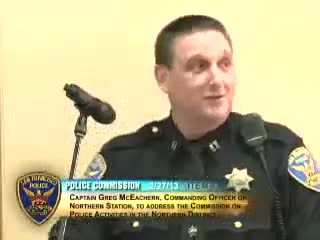
Northern Station captain vows to restore beat officers, targets 5% crime reduction
Summary
Captain Greg McEachern told the Police Commission and about 100 residents that Northern Station will prioritize restoring beat officers when staffing allows and pursue a 5% reduction in crime and a 10% reduction in collisions through enforcement, education and expanded training.
Captain Greg McEachern laid out a multi‑pronged plan to tackle rising property and violent crime in San Francisco’s Northern District, telling residents at a Police Commission community meeting that beat officers will return “as soon as I get the staffing.”
McEachern said Northern Station covers the Marina, Pacific Heights, Polk Street, Fillmore and Lower Haight and currently has 132 sworn officers assigned, with about 104 on the street and eight in training. He reported that the district is up roughly 1% in violent crime year‑to‑date, robberies are up about 16% and property crimes are up about 34%, while auto break‑ins in the district were cited as up approximately 83%.
“Those numbers are unacceptable,” McEachern said. “You will have beat officers back on here as soon as I get the staffing.” He outlined three central strategies: directed enforcement (uniform and plainclothes operations), community education (flyers and merchant outreach), and increased training including crisis intervention for officers and school‑based violence prevention.
McEachern described operational steps the station is taking: targeted enforcement operations in identified high‑crime areas, daily briefings with maps showing hot spots, undercover plainclothes operations to follow thieves, and coordination with the District Attorney’s Office to pursue more aggressive prosecution of repeat offenders. He said the department is running multiple undercover operations focused on auto break‑ins and is teaching recruits and officers how to conduct plainclothes follow‑ups.
On traffic safety, McEachern set a separate goal of reducing collisions in Northern Station by 10% through targeted enforcement of problem intersections and public education. He asked residents to report dangerous intersections and said his team will relay engineering needs (for example, to Muni or the municipal traffic division) where signage or physical changes may reduce collisions.
McEachern urged simple prevention steps for residents and merchants — lock vehicles, remove valuables instead of hiding them under blankets or in visible spots, close glove compartments and call police when someone’s behavior looks suspicious. Flyers with tip lists and a one‑page resource sheet with relevant phone numbers were made available at the meeting.
Next steps: McEachern said beat restoration depends on incoming academy classes and staffing allocations; he pledged to prioritize neighborhood beats as new officers complete training and to continue frequent community meetings and street walks to identify local problems.