Get Full Government Meeting Transcripts, Videos, & Alerts Forever!
Get email alerts on the Police Ois Investigations topic
No spam. Unsubscribe anytime.
Police commission hears detailed briefing on officer-involved shooting investigations
Summary
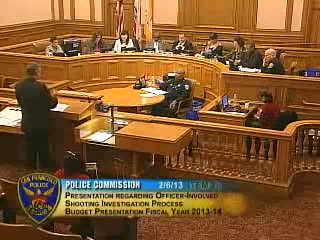
Sergeant Crudo walked the Police Commission through San Francisco Police Department procedures for officer-involved shootings (OIS), explaining the dual criminal and administrative tracks, return-to-duty panels, compelled administrative interviews and the flow of information between agencies.
Sergeant Crudo presented the San Francisco Police Department's process for investigating officer-involved shootings (OIS), defining an OIS as “an intentional discharge by the officer of his weapon” and outlining two concurrent but separate lines of inquiry: a criminal probe led by homicide and the district attorney's office, and an administrative review that evaluates policy compliance.
The department treats OIS incidents as critical incidents and triggers broad notifications from the Department Operations Center. Sergeant Crudo said the criminal and administrative investigations run side by side: “Two separate investigations begin,” he told the commission, with the criminal investigation developing forensic evidence, witness interviews and a homicide report that the DA will review and on which charging decisions depend. The administrative investigation “piggybacks” on criminal work but does not send compelled administrative statements back into the criminal file except as impeachment or when a judge allows it, he said.
Commissioners pressed for specifics about the return-to-duty process and the materials reviewed by decision-makers. Crudo said officers are administratively reassigned for a minimum of 10 days, complete mandatory post-discharge debriefings (including a 72-hour behavioral-science debrief and range/simulator work) and face a return-to-duty panel five business days after the incident. That panel — chaired by the deputy chief of administration and including commanders, internal-affairs and behavioral-science representatives — makes a consensus recommendation to the chief, who may concur or issue his own finding; the chief's decision is then reported to the commission in closed session under department general orders.
Crudo explained the difference in legal standards: the DA's burden for criminal charges is high, while the administrative burden is the preponderance of the evidence (about 51 percent). “Our burden of proof in an administrative investigation is the preponderance of evidence,” he said, adding that administrative investigators routinely rely on interviews and forensic evidence developed by homicide.
The presentation addressed interaction with outside agencies. Crudo said the DA conducts an independent review and may lead charging decisions; the Department of Justice or federal agencies can become involved where conflicts exist or jurisdictional issues arise. He noted dependencies that can delay final administrative findings — for example, toxicology and medical-examiner reports can take time.
Public speakers and commissioners raised concerns about transparency and timing. Ray Hartz (San Francisco Open Government) and public commenters asked why officers may be returned to duty before the full investigative work is complete; commissioners sought clarity about what the chief sees behind the condensed PowerPoint briefings the commission receives and what longer investigative materials are presented in closed session. Crudo and Chief Suhr defended the current practice as designed to balance officer welfare, HIPAA confidentiality and the need for a timely personnel decision, while reserving prosecutorial charging decisions to the DA.
The commission did not adopt any changes at the meeting; the briefing was presented as background to inform later policy review and possible amendments to Department General Orders related to OIS and the FDRB.