Get Full Government Meeting Transcripts, Videos, & Alerts Forever!
Get email alerts on the Clean Power Sf topic
No spam. Unsubscribe anytime.
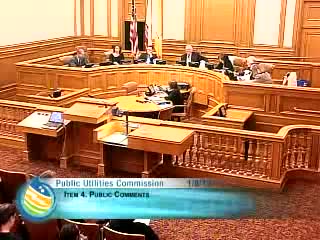
SFPUC hears Clean Power SF update; commissioners and advocates debate scale, borrowing and opt-out rules
Summary
Staff updated the commission on Clean Power SF and PG&E rate changes; a competing 'Local Power' business case envisions large borrowing and local generation, prompting questions about financing, siting, opt-out mechanics and whether the two proposals can be phased together.
The SFPUC received a multi-part progress report on Clean Power SF on Jan. 8, covering recent PG&E rate changes, program timelines and a contrasting "Local Power" business case proposing a far larger build-out.
Barbara Hale, Assistant General Manager for Power, said PG&E’s generation rate rose from 7.1¢ to 7.9¢ per kilowatt-hour on Jan. 1, which reduces the projected premium Clean Power SF customers might pay. Hale said PG&E warned of another roughly 2% transmission-related increase in May. Staff will refresh comparative rate modeling when the commission considers not-to-exceed rate recommendations, with a planned presentation on Jan. 22.
Todd Reedstrom (Assistant GM and CFO) summarized a Local Power Institute (LPI) business case the commission has reviewed. LPI assumes a much larger City program that could require the SFPUC to borrow on the order of $1.0–$1.5 billion, install around 300 locally sited combined-heat-and-power systems and roughly 600 solar installations, and enroll approximately 266,000–267,000 accounts (near-universal participation). Reedstrom warned these assumptions create significant financing, siting and policy risks and said a siting analysis and additional deliverables from contractors are due in January.
Commissioners asked whether the two proposals are mutually exclusive or compatible as phased approaches; staff said Phase A (the commission’s current approach) can proceed while elements of a larger build-out are layered later, but that the larger plan requires policy decisions on city borrowing and cost socialization. Commissioners also pressed City Attorney Laurie Ambrose and staff for clarification on opt-out mechanics; advocates and a public commenter said customers who exercise an initial opt-out may be barred from another opt-out opportunity and not be eligible to opt in for 18 months, making initial opt-out rates crucial to program success.
Public commenters and advocates, including Eric Brooks of the San Francisco Green Party, urged that the Local Power documents be read carefully and that community outreach and survey methodology reflect the full Local Power package. Commissioners called for clear outreach reporting, transparency about contractors that will carry out build-out work, and regular updates on workforce and apprenticeship commitments.
Ending: Staff will refresh rate projections for the Jan. 22 meeting, deliver siting analysis and provide further documentation about phasing, outreach and contractor discussions; the commission deferred any commitment to large-scale borrowing pending further policy guidance.