Get Full Government Meeting Transcripts, Videos, & Alerts Forever!
Get email alerts on the Clean Power Sf Outreach topic
No spam. Unsubscribe anytime.
SFPUC endorses outreach framework for Clean Power SF; commissioners and advocates press for clearer pricing and community outreach
Summary
The joint LAFCO–SFPUC meeting reviewed Clean Power SF’s customer notification and education plan, heard public concerns about outreach, pricing and local build‑out, and the SFPUC moved and approved a resolution advancing the outreach framework and next steps.
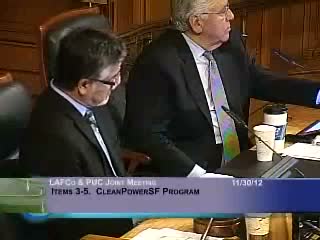
The San Francisco Public Utilities Commission on a rainy morning reviewed and endorsed a framework for the Clean Power SF customer notification and education plan, advancing a schedule of surveys, door‑to‑door outreach and statutory opt‑out notices that staff say are designed to prevent accidental enrollments in the opt‑out community choice aggregation (CCA).
"This program ... is our greatest tool to really assure that we are doing our part around climate change," said Chair John Avalos, opening the joint session with the Local Agency Formation Commission. Assistant General Manager for Power Barbara Hale presented the plan and the implementation timeline, saying the SFPUC has filed a revised implementation plan at the California Public Utilities Commission and expects CPUC certification by its executive director "before January." She asked the PUC to endorse the overall outreach framework.
Hale told commissioners staff will target a first phase of about 20–30 megawatts drawn from city areas where interest is concentrated, and will use multilingual, multimedia and face‑to‑face outreach. She presented projected impacts for a typical Tier 1 household in 2013: a base electric portion of about $21.97 and a projected premium of $11.54 for the Clean Power SF 100% renewable product, producing an average electric portion of roughly $33.50 (about a 52.5% increase on the electric portion and about a 29% premium on the total PG&E bill). Staff said those figures include the PG&E cost responsibility surcharge that can attach when a customer leaves PG&E’s bundled service.
On schedule and contracting, Hale said staff plan a January survey to test the premium and acceptance rates, outreach targeting about 20,000 households with direct conversations with roughly 5,400 households, and a polling/outreach budget of about $1.4 million for the coming year. She said a Shell master agreement is expected to be signed in July, with a PUC confirmation in August that would create a financial obligation staff estimated at about $38,000,000 per year during the 4.5‑year sales period; the opt‑out mailers would begin in mid‑August ahead of an October program launch.
Several commissioners emphasized equity, plain‑English materials and community‑based outreach. Commissioner Olague and others pressed for outreach language that balances cost information with the program’s environmental and local‑jobs goals. Commissioner Moran asked legal and staff teams to ensure the plan stays within state opt‑out law.
Public commenters urged caution and more analysis. Eric Brooks of the San Francisco Green Party warned that a marketing plan built around an $10–$11 premium could be undercut if PG&E’s competing 100% product is cheaper, and urged staff to review new Local Power pricing work before finalizing outreach. Jessica Derwin Ackerman of the Sierra Club and other advocates pressed the commission to integrate local build‑out, jobs and alternative pricing scenarios into outreach and to provide more detail on how outreach will reach communities of color and low‑income neighborhoods.
Hale said the outreach contractor Davis and Associates has been authorized initially with a $100,000 early task order to begin work; staff said they would return to the PUC to request release of additional funds after commissioners have had the fuller conversation. Hale also described survey and outreach mechanics: four legally required opt‑out mailers (two before service and two after) and multi‑language materials targeted to the deep‑green precincts identified on staff heat maps.
After discussion, Commissioner Moran moved "the resolution that's in front of us." The motion was seconded and, on roll call, President Art Torres, Commissioner Gaitor and Commissioner Moran voted "Aye." The chair declared the motion carried and the meeting adjourned. Staff said they will return with implementation steps, rate details and any further information requested by commissioners, including additional detail on outreach to marginalized communities and any updated pricing analyses.
Next steps outlined by staff include the January customer survey to refine the heat map and opt‑out projections, PUC consideration of a not‑to‑exceed rate request in February, and a final rate and confirmation with Shell before the proposed October enrollment launch.