Get Full Government Meeting Transcripts, Videos, & Alerts Forever!
Get email alerts on the Policing Southern Station topic
No spam. Unsubscribe anytime.
Southern Station captain credits outreach and specialized units for sharp drops in several crime categories
Summary
Acting Captain Steve Balma told the Police Commission at a community meeting that Southern Station’s coordinated foot-beat policing, undercover operations and partnerships have coincided with large reporting-period declines in aggravated assaults, robberies and property crimes, while the station continues to handle nearly 10,000 calls monthly and balance staffing demands for major events.
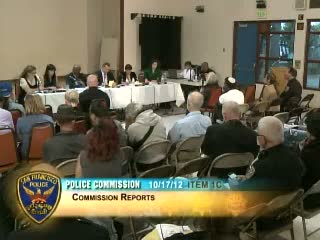
Acting Captain Steve Balma told the San Francisco Police Commission at a community meeting at Southern Station that the district’s combination of foot-beat policing, undercover operations and interagency cooperation has coincided with meaningful short-term reductions in several serious crimes.
Balma said Southern Station recorded one homicide on Oct. 7 (outside the reporting cutoff), and reported reporting-period decreases of 52% in aggravated assaults and 27% in robberies. He also said auto thefts were down 32%, burglaries nearly 40% and personal thefts about 40% during the same 28‑day reporting window. Year‑to‑date figures, Balma added, showed smaller declines in some categories, with robberies up roughly 1% so far this year.
Why it matters: Southern Station is a major transit and events hub — Balma described boundaries roughly Market Street to the north, Embarcadero to the east, Berry Street to the south and Division/Beale to the west — where a nightly residential population of about 26,000 can swell to as many as 300,000 people during conventions, ballgames and major events. The large influx of visitors strains staffing and requires coordination with specialized units and other commands.
Balma credited specialized units for help on undercover buy operations and fugitive arrests, and he said the station’s homicide investigators have worked closely with federal and county partners; he reported arrests in seven of eight homicides in the district so far this year. He also described the district’s staffing profile (day watch and night watch officer counts, PSAs who assist with administrative tasks, and an SIT investigations team currently at six investigators working to return to a normal staffing level of eight).
On community outreach, Balma highlighted long-standing cooperation with the Community Police Advisory Board (CPAB), SF SAFE and other local groups. CPAB members described projects such as the “Be City Smart” pedestrian-safety campaign, translated newsletters and distribution of safety brochures to hotels and businesses to reach residents and visitors.
Balma warned that special events — conventions at Moscone Center, Giants games and multi‑day festivals — require borrowing officers from other units and produce sustained demands on patrol resources. He said the Southern District handles about 10,000 calls a month, roughly 2,300 more than the next busiest station.
The meeting moved from the presentation into public comment and commissioner questions; officers committed to provide station- and citywide data on specific enforcement actions (for example, sit‑lie statistics) upon request. The commission tentatively penciled in a November 14 joint session with the Commission on the Status of Women to review domestic‑violence response work.