Get Full Government Meeting Transcripts, Videos, & Alerts Forever!
Get email alerts on the Oversight topic
No spam. Unsubscribe anytime.
San Francisco Office of Citizen Complaints reports fewer complaints last year, highlights mediation and language access
Summary
OCC Director Joyce Hicks presented the agencys role, investigative standard, and caseload figures: 784 complaints last year, 7% sustained findings and 61 mediations; she emphasized language access and how to file complaints.
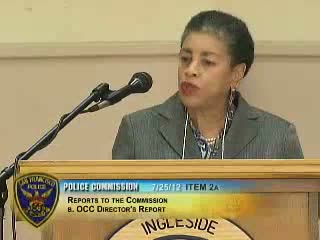
Joyce Hicks, director of the San Francisco Office of Citizen Complaints, reviewed the OCCs role in civilian oversight and gave a detailed description of the agency's procedures and recent statistics during the Police Commissions Ingleside community meeting.
Hicks said the OCC investigates civilian complaints of police misconduct, uses subpoena power when necessary and applies a preponderance-of-evidence standard ("probability greater than 50%") to determine findings. She reported that the OCC received 784 complaints last year — an 8% reduction from the previous year when the agency received 854 — and that sustained findings represented about 7% of cases closed. The OCC facilitated 61 mediations last year, roughly 7% of closed cases, and noted that mediation participation is voluntary for both complainants and officers.
Hicks described the OCC as a separate civilian oversight agency created by a charter amendment in 1982 and stated the office is located at 25 Van Ness Avenue, seventh floor. She emphasized language access: OCC staff speak several languages (Cantonese, Mandarin, Burmese, Tagalog, Spanish) and the OCC conducts non-English intakes and provides interpretation as needed. She noted the OCC's goal is to complete most investigations within nine months and, with limited exceptions, within one year.
The director encouraged residents to contact senior investigator Edward McMahon or visit OCC materials available at the meeting for more information. Commissioners asked follow-up questions; the OCC offered to provide additional details on process timelines and complaint intake by language if requested.
The meeting did not result in rule changes to the OCC's mandate; the director's remarks were presented for information and to improve community understanding of complaint procedures and access.