Get Full Government Meeting Transcripts, Videos, & Alerts Forever!
Get email alerts on the Police Use Of Force topic
No spam. Unsubscribe anytime.
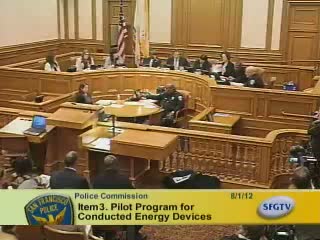
Police commission pauses vote on taser pilot, orders committee to complete community outreach and study
Summary
After heated public testimony and expert testimony about medical risks, the San Francisco Police Commission voted unanimously to remove the possible-action portion of a taser pilot item and directed a commission working group, OCC and SFPD to pursue further study and community consultation before any pilot is approved.
The San Francisco Police Commission on Aug. 1 heard hours of testimony and expert evidence before voting unanimously to remove the "possible action" from a proposed pilot program to equip Crisis Intervention Team officers with conducted energy devices, commonly called tasers.
Commissioner Chesa Chan moved to strip the item of its action component, citing a Feb. 23, 2011 resolution that required a 90-day study and community consultation before any pilot. After extended debate and presentations from SFPD, a Taser International representative and independent medical and civil-rights experts, the commission approved the amendment by roll call (President Mazuko, Vice President Marshall, Commissioners DeJesus, Chan, Kingsley, Turman and Loftus all recorded as "Aye").
The department argued the targeted pilot would be limited to CIT-trained officers and said it hoped the devices could reduce the need for lethal force in incidents involving people in crisis. Commander Mikhail Ali reported that about 74 officers have completed CIT training so far and framed a narrow pilot as an option to "mitigate the need for lethal force." Chief Gregory Sir told the commission that, in his view, having an additional less-lethal option could save lives in critical moments.
Opponents — including civil-rights groups, mental-health advocates and many public commenters who packed the meeting — urged the commission to follow the earlier resolution27s requirement for outreach and to consider alternative options. Dr. Zhan Tsang, a UCSF cardiac electrophysiologist who reviewed peer-reviewed studies and his own epidemiological work, said the literature shows a small but real risk that electrical stun devices can induce lethal arrhythmias under certain vectors, body habitus and high-adrenaline states, and recommended strict restrictions on deployment, avoidance of chest vectors, limits on repeated discharges and availability of AEDs in police vehicles.
Taser International representatives emphasized vendor and government studies finding broad deployment and reductions in some use-of-force injuries, but acknowledged some research and materials are vendor-funded. Commissioners repeatedly pressed for details on total cost, training, deployment protocols, procurement processes and whether other nonlethal alternatives had been assessed; the department said it would follow normal procurement rules and provide more complete cost and policy proposals for committee review.
The commission voted to form a working group (commission members and OCC) to meet with department staff and community stakeholders named in the 2011 resolution. The commission set a schedule for regular report-backs; the department and working group will report on progress and outreach at monthly meetings, beginning with a report-back scheduled for Sept. 5. Any pilot proposal with policy language and procurement details must return to the full commission for consideration.