Get Full Government Meeting Transcripts, Videos, & Alerts Forever!
Get email alerts on the Public Safety topic
No spam. Unsubscribe anytime.
Tenderloin captain outlines Safe Passage, enforcement and staffing challenges
Summary
Captain Joe Garrity told San Francisco’s Police Commission and a packed Tenderloin meeting on June 27 that the station is expanding community programs such as Safe Passage while operating short of historic staffing levels; he and community partners described efforts to curb retail theft, target robberies and refer low‑level cases to the Community Justice Center.
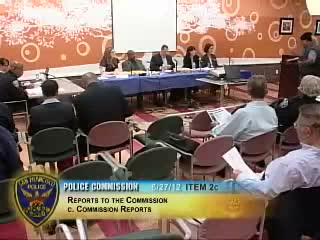
Captain Joe Garrity, commanding officer of the Tenderloin Station, told the San Francisco Police Commission at a June 27 community meeting that the station has prioritized prevention and community partnerships even as staffing lags citywide.
"Prevention, intervention, enforcement," Garrity said as he described the station's approach and noted the district had about 72 sworn officers compared with 91 two years earlier. He said recent staffing actions in the mayor’s budget will add academy classes and civilian hires but warned that expected departures mean the department will remain understaffed through the coming year.
Garrity highlighted a series of programs he said have reduced some crimes and improved neighborhood safety. He described Safe Passage — a street mural and trained community monitors to escort children to school — as near completion and credited community partners including the Boys & Girls Club, La Voz Latina and a Business Improvement District for donations of paint and volunteer labor. Pat Zamora of the Boys & Girls Clubs told commissioners the program trains corner captains and helps hundreds of children walk safely to school.
On crime trends, Garrity said robbery arrests were up substantially even as robbery calls increased, and attributed much of the activity to narcotics‑related thefts and organized retail theft operations. He said the station has worked with major retailers and the DA’s office on retail theft enforcement and noted an uptick in arrest numbers: "Our arrests for robberies are up 49%."
Garrity described partnerships and operational tactics that the station uses to respond to quality‑of‑life issues: stay‑away orders targeted to specific measurable zones, a violence reduction team for hot spots, bicycle and foot beats, and referrals to the Community Justice Center (CJC) for low‑level offenders. He said 554 referrals were made to the CJC, which he described as a way to funnel appropriate cases to services instead of traditional prosecution.
On prescription and illicit pill resale, Garrity acknowledged a growing, complex problem and said the station is coordinating with other agencies and the DA’s office on a multi‑agency response. He emphasized the importance of follow‑up and local investigations, and urged patience as additional academy classes and civilian hires take effect.
Commissioners asked specific operational questions about crisis intervention training (CIT) and violence clearance rates. Garrity said the station had roughly eight to nine CIT‑trained officers and expressed a wish to expand training to sergeants so supervisors better support crisis responses.
The presentation drew repeated praise from commissioners and community leaders for the station’s outreach. Garrity closed by saying community engagement and incremental improvements remain the station’s strategy while resources are constrained; the commission then moved to questions and public comment.