Get Full Government Meeting Transcripts, Videos, & Alerts Forever!
Get email alerts on the Infrastructure topic
No spam. Unsubscribe anytime.
PUC adopts policy making it responsible for pedestrian lighting on city streets
Summary
The SFPUC voted to adopt Policy No. 1, making the commission responsible for pedestrian lighting operation and maintenance on city streets; staff said the PUC currently operates 398 pedestrian lights and expects O&M costs to rise from about $24,000/year to roughly $37,000 over 10 years.
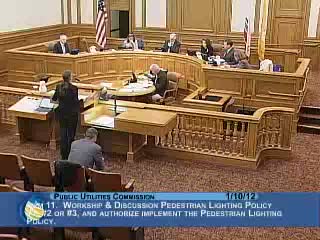
SAN FRANCISCO — The San Francisco Public Utilities Commission voted to adopt Pedestrian Lighting Policy No. 1, assigning the PUC responsibility for pedestrian lighting in public streets, including operation and maintenance.
Barbara Hale, Assistant General Manager for Power, presented three options and recommended Option 1: full PUC responsibility for power, operation and maintenance for pedestrian lighting installed in the public right‑of‑way. "We recommend option number 1, which would have the PUC responsible for pedestrian lighting in city streets," she said. Hale told commissioners the PUC already operates 398 pedestrian lights and currently incurs "a little over $24,000 a year in operations and maintenance costs," which staff estimate could grow to about $37,000 annually after 10 years as the program expands.
Advocates of the motion argued Option 1 provides consistency, efficiency and a single point of contact for developers and neighborhoods as the Board of Supervisors' Better Streets plan rolls out. Commissioners noted that, while O&M costs are modest today, the commission will need to work with the Department of Public Works and other partners to coordinate installations and compensation when lighting is co‑located on poles or circuits.
A motion to adopt Policy No. 1 was made, seconded and approved by voice vote; the president declared "The motion carries." The commission also noted that some revenue changes in the new rates structure will modestly affect streetlight funding arrangements going forward.
Staff will implement the adopted policy and coordinate with DPW on street‑selection, contract mechanisms and accounting for shared repaving or pole usage costs.