Get Full Government Meeting Transcripts, Videos, & Alerts Forever!
Get email alerts on the Hecth Hetchy Rates topic
No spam. Unsubscribe anytime.
PUC weighs 2¢ or 4¢ rate increases to shore up Hetch Hetchy power finances and fund Clean Power SF
Summary
Staff presented two options to make Hetch Hetchy Power financially sustainable: a baseline 2¢/kWh increase over two years to stabilize reserves and enable bonding, or a 4¢/kWh path over four years to also restore renewables and efficiency programs. Commissioners directed staff to continue outreach to the mayor and supervisors and return with refined proposals.
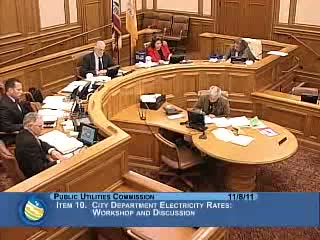
The commission received a detailed financial briefing from Todd Reedstrom, assistant general manager and CFO, about the Hetch Hetchy power enterprise and options to restore long-term fiscal sustainability.
Staff presented two bookend rate scenarios for municipal department electricity: a baseline option that raises rates by 2 cents per kilowatt-hour phased over two years (raising the average charged to general-fund departments from about 3.75¢ to 5.75¢), and a restoration option of 4 cents over four years that would fund the baseline and allow the restoration of city-owned renewables and energy-efficiency programs. Reedstrom explained each penny of increase is roughly $4.5 million in revenue; the current implicit annual subsidy to city departments from below-cost rates is about $23 million.
The 2¢ option would enable the commission to present a track record of sustainable rates to the bond market and pursue revenue bonds for long-lived power capital projects; staff said it would not fully restore deferred renewables and efficiency programs. The 4¢ option would, over the multi-year horizon, permit restoration of those programs and support Clean Power SF startup funding. Staff estimated Clean Power SF startup needs in their modeling at about $19.5 million (one-time), and emphasized the timing of rate increases affects borrowing capacity, reserve policies and program restoration.
Commissioners discussed how the general fund would absorb the increases, the importance of meeting reserve policies, equity and policy trade-offs about whether all embedded power costs should be allocated to user departments, and that a longer-term outreach and education effort is needed to bring supervisors and the mayor’s budget office on board.
Public advocates (including energy and climate groups) told the commission they support realistic rates tied to long-term investment in renewables and efficiency but urged staff to use careful scoping and to package rate proposals with targeted energy-saving measures so departments can offset higher rates through reduced consumption and local projects.
The commission asked staff to continue outreach (mayor’s budget staff, Board of Supervisors budget committee and affected departments), to return with refined rate design options and departmental impact analyses, and to present a proposed schedule for deliberation at the December meeting. No final rate decision was made on Nov. 8.