Get Full Government Meeting Transcripts, Videos, & Alerts Forever!
Get email alerts on the Mental Health Training topic
No spam. Unsubscribe anytime.
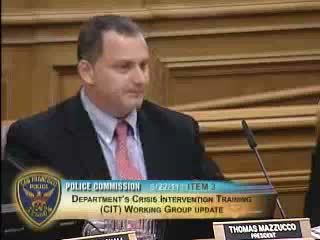
Police commission reviews Crisis Intervention Team curriculum, plans pilot training in Tenderloin
Summary
Police commissioners received a detailed update on a 40-hour Crisis Intervention Team curriculum emphasizing behavior-based de-escalation, role-play and people-with-lived-experience participation; pilot classes of about 25 volunteer officers are planned for the Tenderloin, Southern and Mission stations with a targeted POST submission and an initial rollout in July'August.
The San Francisco Police Commission on June 22 received a detailed briefing on a proposed Crisis Intervention Team (CIT) training program that organizers say will equip officers with behavior-focused de-escalation tools and scenario-based practice.
Captain John Goldberg, who leads the department's administrative implementation work, told commissioners the committee has drafted a 40-hour curriculum organized around daily themes such as suicide, voices and hallucinations, veterans and trauma, and agitated behavior. "Training is only one aspect of a much bigger picture," Cecile O'Connor, program director at the Dort Urgent Care Clinic, told the commission, urging partnership with community providers and people with lived experience.
The committee said the training will emphasize role play, case studies and direct consumer interface, with consumers and family members speaking each day. The presenters said the focus on observable behavior rather than diagnostic labels will help officers identify and respond to common crisis situations; O'Connor summarized the program's scope by noting that "one out of every four calls the police respond to" has some component tied to mental health or behavioral-health issues.
Operational planning includes an interim department bulletin that establishes an immediate "stand down/secure perimeter/call for supervisor" procedure when a mental-health component is identified. Organizers have proposed pilot classes of roughly 25 volunteer officers each at three high-volume stations (Tenderloin, Southern and Mission), with the Tenderloin scheduled first so the department can evaluate lessons and adjust subsequent sessions.
Committee members said the goal is to train roughly 20'25% of the patrol force over time by rolling classes out across shifts; the first two sessions would be spaced about a month apart to allow adaptation based on feedback. Captain Goldberg said ride-alongs and a previous working-group trip to Memphis informed curriculum choices and that the committee will submit materials for POST certification once the curriculum is finalized.
Commissioners pressed for data-driven selection of topics and for evaluation plans. Presenters said they are working with local partners, including UCSF Langley Porter, to develop metrics and analyze whether CIT reduces response time or improves outcomes. The committee also discussed a cautious approach to videotaping training, suggesting recordings might be made available after early sessions once kinks are worked out.
Commissioners praised the collaborative process, and Commissioner Angela Chan was recognized for leadership pushing the program forward. The commission did not take a formal vote on the curriculum at the meeting; presenters said they expected POST certification and an operational pilot to follow once trainers and instructors are finalized.
The commission's next steps: finalize the curriculum, pursue POST certification, run an evaluated pilot in the Tenderloin, and report back on outcomes before broader rollout.