Get Full Government Meeting Transcripts, Videos, & Alerts Forever!
Get email alerts on the Regional Desalination topic
No spam. Unsubscribe anytime.
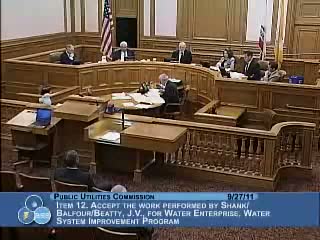
SFPUC votes 3–1 to fund next phase of Bay Area regional desalination study
Summary
The San Francisco Public Utilities Commission voted 3–1 to spend $200,000 and contribute staff time toward site‑specific studies for a Bay Area regional desalination project, after a lengthy presentation, Q&A about governance and carbon footprint, and robust public comment.
The San Francisco Public Utilities Commission voted 3–1 on Sept. 27 to advance site‑specific studies for a Bay Area regional desalination project, approving a $200,000 cash contribution and a staff‑time commitment to help pay for hydraulic, Delta water‑quality and greenhouse‑gas analyses.
Assistant General Manager Steve Ritchie told commissioners the multiagency effort dates to 2003 and has already produced feasibility and pilot work. He said the next phase would test specific sites and conveyance options, with tasks including hydraulic modeling of East Bay delivery systems, Delta water‑quality and supply modeling, greenhouse‑gas analysis, and a public and regulatory outreach program. Ritchie estimated San Francisco’s additional cash contribution at about $200,000 on top of roughly 340 staff hours, and described the regional cost‑sharing approach as equal contributions from participating agencies.
Commissioners asked detailed questions about governance, voting rules and decision thresholds for a potential regional entity; Ritchie said options range from memoranda of understanding to a joint powers agreement and that protections could be written into any future agreement. Commissioners also pressed staff about how the commission would weigh trade‑offs — including carbon footprint versus yield and cost — when comparing desalination to conservation, recycled water or transfers.
Public commenters were sharply divided. Proponents from partner agencies said the studies will help emergency preparedness, integrated planning and potential regional reliability gains. Environmental and consumer‑advocacy speakers warned desalination is energy intensive, risks impacts to fisheries and the Bay ecosystem and could undercut conservation and local reuse options. SPUR (San Francisco Planning + Urban Research Association) urged completing the feasibility work to inform longer‑term planning; Food & Water Watch and local environmental advocates urged investment in conservation and green infrastructure instead.
Commissioner Torres was the lone no vote. Vice President Moran, Commissioner Kane and Commissioner Courtney voted to approve the staff recommendation as amended to clarify that the project would explore delivery for both the commission’s retail and wholesale customers. The final tally recorded three ayes and one no.
The commission’s action authorizes staff to proceed with the site‑specific studies and related outreach; it does not approve construction of a desalination plant. Any project beyond the studies would require additional environmental review under the California Environmental Quality Act and separate future approvals by participating agencies.