Get Full Government Meeting Transcripts, Videos, & Alerts Forever!
Get email alerts on the Youth Policing topic
No spam. Unsubscribe anytime.
Youth commission's training and school MOU recommendations win SFPD support; academy rollout set for June
Summary
The San Francisco Police Department agreed to adopt youth-focused training, broader distribution of juvenile 'know your rights' pamphlets and to pursue an MOU with the school district; a 50-member basic recruit class was scheduled to start June 25 to host the first training pilot.
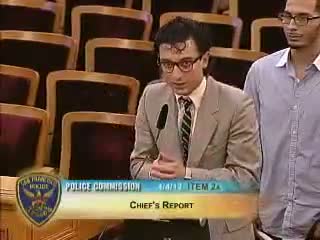
The San Francisco Police Commission on April 4 received a youth commission presentation urging new training for officers who interact with juveniles, wider distribution of juvenile "know your rights" materials, and an updated memorandum of understanding with the school district to standardize school- police relationships.
Mario Yedidia, staff to the youth commission, summarized the March 7 joint hearing that produced the recommendations and introduced youth commissioners who later detailed the proposals. Renounce Barros, chair of the youth justice committee, called for training that includes adolescent cognitive development, mental health awareness and scenario-based exercises to teach de-escalation and youth engagement skills. Javonte Holloway, a youth commissioner, urged distributing juvenile "know your rights" pamphlets to middle and high school students and community organizations. Angel Carreon recommended standardizing relationships between district stations and schools through an MOU clarifying on-campus arrests, roles of school security and school resource officers (SROs).
SFPD representatives told the commission they planned to move quickly. A captain overseeing the academy said a 50-member basic recruit class was scheduled to begin June 25 and that the department intended to embed youth-focused training into that class and pilot scenarios with youth from different neighborhoods. The chief said a draft training could be ready within 90 days and that the department could standardize academy and in-service training within six months; he added pamphlets could be distributed as soon as they are printed and that an MOU timeline would require involvement from the city attorney.
Commissioners praised the recommendations and urged rapid follow-through; several suggested pairing the rollout with external funding sources and retired-officer support to expand programs. No formal vote was taken; the commission and the chief agreed to return with implementation details and timelines.