Get Full Government Meeting Transcripts, Videos, & Alerts Forever!
Get email alerts on the SSIP Program Management topic
No spam. Unsubscribe anytime.
SFPUC approves AECOM‑Parsons program‑management selection for massive sewer rebuild amid community equity concerns
Summary
The San Francisco Public Utilities Commission voted to move forward with selecting the AECOM‑Parsons joint venture as program manager for the Sewer System Improvement Program, a 15‑year, up‑to‑$150 million professional services arrangement. Community speakers pressed the PUC for stronger local hiring and greater Black contractor inclusion in procurement panels.
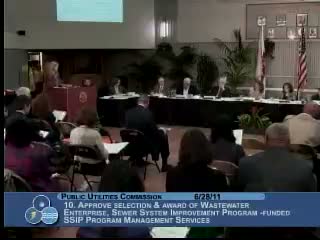
The San Francisco Public Utilities Commission voted to approve the selection of the AECOM‑Parsons joint venture as program management consultant for the Sewer System Improvement Program (SSIP) and authorized the general manager to negotiate a professional services agreement not to exceed $150 million over a 15‑year term.
Karen Kubik, director of the sewer system improvement program, told the commission the SSIP is a multi‑billion‑dollar capital effort and that roughly half of the program’s $6.9 billion portfolio will be invested in the southeast neighborhoods adjacent to the treatment plant. The RFP drew three consultant teams; AECOM‑Parsons scored highest on both written proposals and interviews and no formal protest was filed, Kubik said.
Why it matters: the SSIP will direct billions of dollars of construction and related contracts in neighborhoods with long histories of environmental and economic disadvantage; community advocates pressed the commission to ensure the work benefits local residents through jobs, training and participation by local businesses.
Community reaction and equity questions Commissioners opened the item to public comment and several speakers raised concerns about procurement diversity and local hiring. Commissioner Torres asked staff how many African Americans served on the final evaluation panel; staff reported panels included people of Asian and Indian heritage but that no African American evaluator sat on the final recommendation panel, though African Americans participated in the RFP production and process. Kubik said African American staff from contracts and other city offices had been involved in the procurement process. Harlan Kelly, assistant general manager, described lessons learned from past program‑management arrangements and stressed that the long contract term aims to preserve continuity and reduce costs.
Public commenters pressed for local hire and increased participation by Black‑owned firms. Charlie Walker, president of the Truckers and Contractors Association, said the city’s large construction programs have left Black contractors largely excluded and asked the PUC for data on how many African American firms hold city contracts. Francisco De Costa urged oversight and even a grand jury inquiry given prior program losses tied to earlier capital programs.
Next steps and approvals Staff said the contract recommendation will be routed to the Board of Supervisors for the customary approvals; the PUC expects the consultant to be on board by September if the contract is approved by all required bodies. Commissioners moved and seconded the item; after public comment the commission approved the recommendation by voice vote.