Get Full Government Meeting Transcripts, Videos, & Alerts Forever!
Get email alerts on the Wsip Update topic
No spam. Unsubscribe anytime.
SFPUC says WSIP remains under budget regionally but local projects face delays and overruns
Summary
SFPUC staff told commissioners the Water System Improvement Program is now forecast to be $148 million under budget on the regional side but $43 million over on the local side, with schedule slips tied to Calaveras Dam and the Westside recycled water environmental review.
The San Francisco Public Utilities Commission heard a quarterly update on the Water System Improvement Program (WSIP) on May 11, 2011, as staff outlined a mixed set of budget and schedule results.
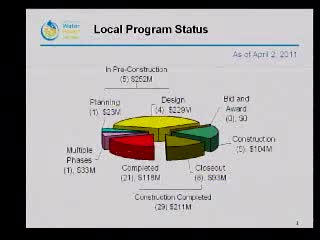
Julie Labonte, WSIP director, said the regional program is now forecast to finish about $148 million under its approved budget while the local program is forecasted to be $43 million over, a $12 million increase from the prior quarter. Labonte said two large water-supply projects account for roughly 72 percent of local project value.
"We are now forecasting program costs to be $148,000,000 less than approved budget" on the regional side, Labonte told the commission, and on the local side "we are now forecasting to be $43,000,000 over the approved budget." She attributed much of the local increase to two water-supply projects and to scope refinements on major works.
Labonte said recent schedule changes move regional completion about eight months later than previously forecast and the local program about 22 months later, with the Westside recycled water project and the Calaveras Dam replacement singled out. She said the Westside project encountered major challenges in its environmental review that required additional workshops and reconsideration of siting alternatives; Calaveras added eight months after a third-party design review recommended contingency for work stoppages on hot, dry days to control naturally occurring asbestos exposure.
Staff identified several drivers of cost increases: higher delivery and soft costs (design, construction management and environmental work), a 35 percent revision to a design estimate on the regional groundwater storage-and-recovery project, additional environmental mitigation and permitting requirements and construction-stage discoveries, including archaeological sites and contaminated soils.
Labonte also highlighted program successes: certification of two environmental impact reports (including Calaveras), advertisement of three major contracts, initiation of construction on six large projects and completion of several others. She invited commissioners to a ribbon-cutting on June 2 for the University Mount Reservoir, which is about to be refilled after two years of work.
Commissioners asked staff to provide updated unit-cost spreadsheets and to formalize the program's postmortem process so lessons from contract modifications and unforeseen conditions are documented and used to reduce repeat occurrences.
The commission discussed ongoing oversight and next steps for program revisions that staff will present for approval in July. The WSIP report will form the basis of proposed program schedule and budget revisions the commission is expected to consider in the coming months.