Get Full Government Meeting Transcripts, Videos, & Alerts Forever!
Get email alerts on the Language Access topic
No spam. Unsubscribe anytime.
SFPD told to fix language-access gaps after advocates describe victims left waiting for interpreters
Summary
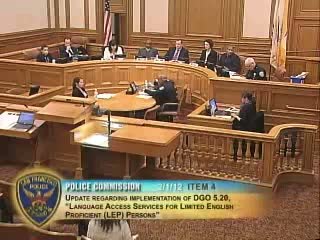
At the Feb. 1 Police Commission hearing, the SFPD described technical and staffing fixes to implement Department General Order 5.2, while domestic-violence advocates recounted recent cases in which monolingual survivors waited hours for interpreters. The commission and OCC urged roll-call training, a written departmental bulletin and tightened dispatch reporting.
The San Francisco Police Department on Wednesday told the Police Commission it has begun technical changes and operational steps to comply with the city’s language-access rules after advocates described recent cases in which limited-English-proficient victims were left without timely interpreters.
The department’s language-access officer, Henry, said staff found one public form, SFPD 164a ("unlicensed driver hold harmless"), had not been translated into the city’s five core foreign languages and that a city-approved vendor quote and an approved memorandum for immediate translation had been submitted. He said the department is working with LanguageLine to change a pre-call question so interpreters record CAD numbers (computer-assisted dispatch) rather than case numbers; capturing CAD numbers lets staff remotely check whether an incident report was later filed and thus satisfy DGO 5.2’s data-reporting requirements.
Why it matters: DGO 5.2 and the city’s language-access ordinance require the department both to provide interpretation and to report annually on how many calls or investigations involved limited-English-proficient (LEP) people, how interpretation was provided, and any language-access complaints and resolutions. Advocates told the commission the reporting and day-to-day delivery have not matched the policy.
Advocates who work with domestic-violence survivors described recent failures. A representative from Women Inc. recounted a monolingual Spanish-speaking client who made a police report but was not provided a certified interpreter; instead a staff member was asked to translate, then the client left after several hours and returned to a different station, where the same delay occurred. "She waited five hours," the witness said. "There was no attempt made to find a certified translator, and the language line wasn't even brought up as a possible option." The witness asked the commission for roll-call training, a department directive, and regular follow-up meetings.
Deputy Chief Kevin Cashman called the anecdote "inexcusable," apologized on behalf of the department, and said he would use the case as a training moment and follow up with commanders. "We want to make sure that individual is treated with the dignity and respect that they deserve," Cashman said.
The Office of Citizen Complaints (OCC) reported it has fielded 24 language-access complaints in the last two years, nine of which involved training failures and were sustained. Sam Ramarian of the OCC told the commission he had presented recommendations to the department: roll-call training based on the OCC’s materials, a deputy department bulletin within 30 days to reinforce DGO 5.2 practice, and improvements to the DEM–SFPD dispatch protocol so language requests are reliably logged.
Commissioners and community groups also urged clearer timelines and benchmarks. Beverly Upton of the San Francisco Domestic Violence Consortium said the coalition has already seen progress — including a community meeting scheduled at Mission Station — but requested written timeframes for implementing the OCC recommendations and periodic reporting to the commission.
What the department will do next: The language-access officer said the administration has approved the change to how LanguageLine collects CAD numbers; he expects that change to allow more accurate annual reporting to the commission. The department also committed to follow up on the Mission Station meeting and to consider roll-call training and a departmental bulletin to reduce repeat failures.
Public-record context: The department’s update and the OCC’s statistics will be part of the documentation the commission expects to receive as the OCC prepares its annual report and a comprehensive January statistical report to be delivered at the commission’s March 7 meeting.
Ending: Commissioners closed public comment after additional community statements and scheduled follow-up items; the commission and department agreed to pursue the technical fix with LanguageLine and to move forward on training and reporting timelines.