Get Full Government Meeting Transcripts, Videos, & Alerts Forever!
Get email alerts on the Language Access topic
No spam. Unsubscribe anytime.
Police Commission presses department on language-access implementation under DGO 5.2
Summary
The San Francisco Police Commission heard a detailed presentation on implementation of Department General Order 5.2 on language access, including staffing, use statistics and recommended dispatch and training upgrades. OCC and community groups urged more tracking, interpreter training and budgeted resources.
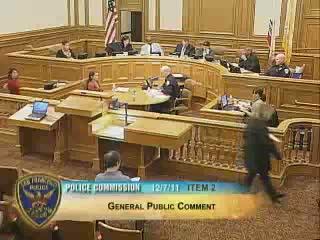
The San Francisco Police Commission on Dec. 7 heard a detailed update on the San Francisco Police Department’s efforts to implement Department General Order 5.2, the city’s language-access policy, and recommendations from the Office of Citizen Complaints and community groups.
Henry, the department’s language-access officer, told the commission that “as of November 2011 the San Francisco Police Department has a total of 2,627 members,” and that about 467 members are bilingual, with 163 certified for the five core foreign languages identified by the city. He presented department data showing officers encounter limited-English-proficient (LEP) speakers roughly 50 times a day across SFPD and explained the department’s current mix of local bilingual officers, civilian interpreters and commercial telephonic services.
Amara Mary, a policy analyst for the Office of Citizen Complaints, urged the department to prioritize a set of OCC recommendations adopted after the DGO’s passage. “The best way to communicate is in the language of the individual,” Mary said, and recommended strengthening the 9‑1‑1/dispatch system so dispatchers can identify on-duty officers’ language skills in real time; expanding interpreter training for bilingual officers and civilian staff; and improving data collection so the department can track whether contacts with LEP speakers are handled by bilingual officers, civilians or LanguageLine Services.
Department staff said some steps already have been taken: translation of juvenile-justice brochures and forms into five dominant non‑English languages, purchase of wireless remote interpreter receivers for community meetings, and interpreter training offerings in Spanish and Cantonese tied to domestic-violence response. Henry also cited cost estimates discussed during implementation planning — for example, a 2008 estimate of about $57,000 to add dispatch capability to display certified bilingual officer availability on dispatcher terminals — and warned that dispatching only bilingual officers could slow response times and jeopardize officer or public safety.
Commissioners pressed staff on specific implementation steps. Commissioner Petra de Jesus asked whether a single cell phone or device per patrol car could be a feasible substitute for issuing phones to every officer; Commissioner Carol Kingsley requested a language-by-language breakdown of certified interpreters; and other commissioners asked about required signage, whether Miranda warnings are provided in LEP speakers’ languages, and whether quarterly and biannual reports called for in DGO 5.2 have been produced.
Community advocates at the meeting, including the Domestic Violence Consortium, described cases in which LEP victims received inaccurate or incomplete reporting, which they said can chill reporting and jeopardize investigations. Beverly Upton of the consortium warned that “seven out of 10 of our victims in 2010 had this issue,” and urged the department and commission to protect LEP victims and prioritize language access in budgeting and training.
The department agreed to supply more detailed data and to return with follow-up information, and commissioners discussed scheduling a community meeting in January to continue implementation planning. The commission also urged that language access be considered as a distinct budget line so upgrades and training can be funded.