Get Full Government Meeting Transcripts, Videos, & Alerts Forever!
Get email alerts on the Pedestrian Lighting topic
No spam. Unsubscribe anytime.
PUC weighs taking ownership of pedestrian-scale streetlights amid cost concerns
Summary
The PUC considered a policy to assume operations and maintenance of pedestrian-scale lights installed along streets if they meet pre-approved standards; commissioners raised cost, budget and jurisdiction concerns and asked staff to return with standards and options (including limited acceptance for Fillmore Jazz District).
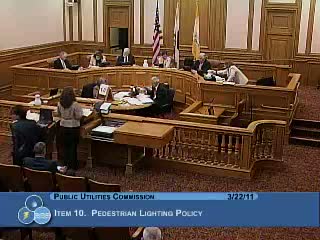
The San Francisco Public Utilities Commission spent an extended portion of its March 22 meeting debating a proposed pedestrian lighting policy that would clarify the commission’s role in reviewing designs and assuming maintenance responsibility for pedestrian-scale streetlights installed on city streets.
Assistant General Manager Barbara Hale told commissioners the ambiguity stems from multiple agencies (PUC, Department of Public Works, Recreation and Park, Port) and that the city’s Better Streets Plan makes pedestrian lighting more likely in future projects. Under the staff proposal the PUC would assume ongoing operation and maintenance for pole-mounted pedestrian lights that meet a pre-approved portfolio of fixtures, meet conduit and pull-box standards, and pass PUC inspection.
Staff presented two cost scenarios: a hypothetical five-mile corridor with pedestrian lighting spaced ~100 feet apart would cost about $16.8M for fixtures plus about $2.24M for conduit and pull boxes, whereas a more modest scenario of 37 lights per year for 20 years would produce total capital costs near $12.95M with lower annual O&M (staff cited approximately $303,000 O&M for LED fixtures in year 20). Commissioners questioned whether the utility should accept capital and ongoing costs given tight finances and competing programs.
Commissioner Moran argued for standard-setting and cautioned against committing scarce funds; other commissioners emphasized public-safety and the risk of lights remaining in limbo if the PUC refuses to accept responsibility. Commissioners proposed options including: adopt the policy but specify it does not create a new financial obligation; restrict acceptance to lights brought to the PUC at planning stage; or take responsibility for specific historical areas (notably the Fillmore Jazz District) where lights are already installed and in need of maintenance.
The commission asked staff to return with a standards portfolio, cost scenarios, and an amendment that clarifies the policy does not automatically imply a capital or O&M obligation for all city pedestrian lighting projects.
Direct quote: "If we're gonna get stuck with them, at least make sure they're the right kind of lights that we can maintain," said a commissioner during debate.
Next steps: Staff will finalize a draft portfolio of approved fixtures and specifications and return with financial options and language to limit implied obligations; commissioners floated continuing the item for 3–6 months while staff negotiates with owners of existing installations.