Get Full Government Meeting Transcripts, Videos, & Alerts Forever!
Get email alerts on the Wastewater Chemicals topic
No spam. Unsubscribe anytime.
SFPUC defends concentrated bleach use, emphasizes odor-control alternatives after media attention
Summary
The San Francisco Public Utility Commission said it does not discharge sodium hypochlorite (bleach) to the bay and outlined odor-control steps—vent stacks, sewer cleaning, grease-to-biofuel programs and pilot trials of biological products—while acknowledging rising sodium-hypochlorite use for wastewater odor control.
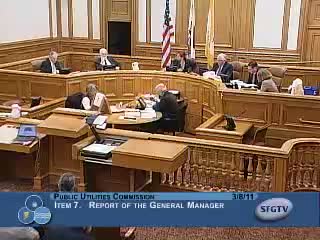
Tommy Mualala, assistant general manager for wastewater, told the San Francisco Public Utility Commission that the agency uses a concentrated sodium hypochlorite solution (about 12–15%) for disinfection and odor control and that the PUC does not dump bleach into the bay.
"Absolutely not," Mualala said. "Our permit specifically says, thou shalt not dump any bleach, any residual bleach into the bay or receiving water." He said the PUC dechlorinates wastewater effluent before discharge using sodium bisulfite and runs fish bioassays to verify no toxic effect.
The presentation explained how the chemical is one of several tools for odor control. Mualala described site-specific engineering steps—elevated ventilation stacks, targeted chemical dosing, aggressive sewer cleaning (he cited annual spending of about $3.5–$4 million on sewer cleaning and inspection), and a grease-to-biofuel program—while stressing there is no single "magic bullet." He told commissioners the PUC is testing biological and enzyme products but that pilot tests to date have not matched manufacturers' claims.
Public commenters and a private-sector technical representative urged the utility to pursue alternatives. Drummond Lawson, director of sustainability at Method Products, offered oxidation-chemistry expertise; other commenters urged piloting constructed wetlands, living machines and composting toilets as ways to reduce stormwater and organic loads that drive odor-control needs.
Mualala said sodium hypochlorite usage has increased for some wastewater applications even as overall chemical additions declined; he stressed staff are searching for nontoxic, effective alternatives and will include alternative analyses in forthcoming project procurement and program-management efforts. He also acknowledged the link between increased conservation and potential odor control challenges in wastewater systems and said the PUC will evaluate engineering and nonchemical measures as it designs its new sewer improvements.
The commission did not take a separate formal action on the update but directed staff to continue testing alternatives, coordinate pilot work and stay in close public communication as potential replacements are evaluated and procurement proceeds.