Get Full Government Meeting Transcripts, Videos, & Alerts Forever!
Get email alerts on the Police Oversight topic
No spam. Unsubscribe anytime.
OCC report shows falling complaints but warns of staffing gap; stop-data jurisdiction remains contested
Summary
The Office of Citizen Complaints reported a decline in complaints and increased mediation success, while director Joyce Hicks warned of investigator staffing shortfalls and urged resources for IT systems. Commissioners debated whether the OCC or SFPD should investigate officers’ failure to enter stop data.
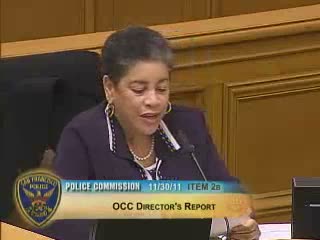
The Office of Citizen Complaints reported modest improvements in complaint handling on Nov. 30, 2011, but its director said the office still lacks the staff and tools needed to meet charter mandates. Director Joyce Hicks told the San Francisco Police Commission that the OCC opened 622 complaints and closed 618 in the third quarter of 2011 and that mediation continues to be a strong component of the office’s work.
Hicks said the OCC mailed 2,000 Behavioral Science Unit surveys and received 126 responses; roughly 96% of respondents recommended BSU services and 60% rated services as excellent. She also described staffing gaps: the OCC had 12 fully trained investigators at quarter close, short of a charter-required ratio the office interprets as 15 investigators and well above a best-practice caseload of 16 cases per investigator. "We are still not at the . . . journey-level investigator level," Hicks said, noting the office expects to have an additional investigator on board by the beginning of the year.
Hicks identified specific unfunded technology recommendations from a prior controller’s audit: an automated "tickler" system for investigation deadlines (estimated $7,000) and an online complaint-filing portal (estimated $12,000). She said security concerns, the complexity of OCC systems and one overburdened information systems analyst constrain how quickly those options can be implemented.
Commissioners pressed Hicks on oversight of stop-data reporting — whether the OCC or the SFPD should investigate failures to enter stop data into departmental records. Hicks said the OCC has authority under City Charter section 4.127 to add allegations discovered during investigations and to address neglect of duty; commissioners and staff noted that the department often conducts data-heavy work because it has system access that OCC investigators lack. "The department provides us with data on whether or not an officer entered this traffic stop information," Hicks said, describing coordination and tension between timeliness and access to records.
The commission asked for the department correspondence referenced in OCC materials and requested updates in future chief’s reports. No formal action was taken on jurisdiction in the meeting; commissioners asked staff to provide additional documentation for later review.
The OCC also reported October-year-to-date figures: 669 complaints filed as of Oct. 31, 2011 (a 10% decrease from 2010) and a sustained-rate of about 8% of closed cases. Hicks cited two recent chief-level adjudications that implemented OCC findings, including admonishment for failure to collect stop data and a suspension that resulted from mishandled property.