Get Full Government Meeting Transcripts, Videos, & Alerts Forever!
Get email alerts on the Patrol Specials topic
No spam. Unsubscribe anytime.
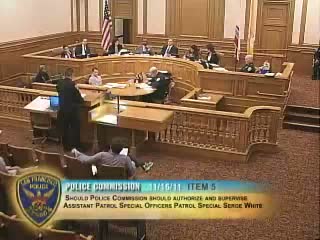
Police commission moves to study patrol-specials rules after repeated compliance complaints
Summary
Commissioners heard Sergeant Giacino and public commenters say patrol-special beat owners are relying on assistants or selling beats without documented transfers; the commission directed Commissioner De Jesus to work with the city attorney for a 30—5-day follow-up and possible rule revisions to Rules 4.11 and 4.12.
The Police Commission opened a lengthy discussion about Rules 4.11 and 4.12 governing patrol-special beat owners and their assistants after Sergeant Hector Jacino raised repeated examples of noncompliance and ambiguous practice.
"Patrol specials must personally participate in the patrol of their beats," Sergeant Jacino said while reading Rule 4.11, and he told commissioners he had found instances where beat owners were medically unable to work but allowed assistants to perform long-term beat duties without proper paperwork. He cited a specific case involving a beat owner identified in the transcript as Serge White and said White had told staff he was "medically unable to work this beat" and had allowed assistants to work it.
Commissioners debated whether Rule 4.12 (which permits assistants when an owner is off duty for more than four days) conflicts with the 4.11 requirement that owners "personally participate." Commissioner Slaughter and others argued the rules can be read consistently but agreed the program has enforcement problems: missing sale paperwork, gaps in station logs and inconsistent liaison staffing that let noncompliance persist.
Public commenters, including long-time critics and current applicants, described the program as "pay-to-play" and urged stricter enforcement, penalties for nonperformance and greater transparency on beat sales, insurance and background checks. Ray Hartz of San Francisco Open Government told the commission enforcement without penalties is like "rearranging deck chairs on the Titanic," urging contractual penalties tied to documented check-ins.
After discussion the commission asked Commissioner De Jesus to lead a legal and policy review with the city attorney, the department and representatives of the patrol-special officer association and return with recommendations in roughly 30—5 days. Commissioners flagged worker's-comp exposure, a backlog of missing documents, and the need for clear timelines for incapacitated or deceased beat owners.
The commission did not adopt immediate rule changes but directed staff and legal counsel to draft options, including strengthening documentation requirements, defining allowable assistant roles, setting notification deadlines for incapacitated or deceased owners, and options for reissuing vacant beats.