Get Full Government Meeting Transcripts, Videos, & Alerts Forever!
Get email alerts on the Officer Training topic
No spam. Unsubscribe anytime.
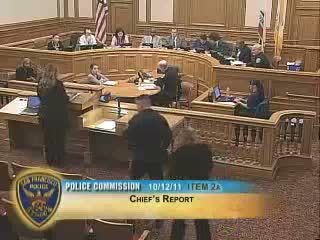
Chief outlines new behavioral-science training, crime trends and Occupy SF outreach
Summary
Chief Gregory Sir told the Police Commission the department plans expanded behavioral-science support and training for officers, reported recent crime reductions and described outreach and sanitary interventions at Occupy San Francisco.
Chief Gregory Sir presented the department’s operational and policy updates at the commission’s Oct. 12 meeting, describing planned training changes, recent crime trends, and the department’s approach to Occupy San Francisco.
The chief said leaders recommended three mandated Behavioral Science Unit (BSU) check-ins — an immediate debrief, a 30-day follow-up, and a later session — and that the draft language will go to the city attorney, command staff and fiscal reviewers in November. He said the academy would increase the behavioral-science continuing professional training block from two to three hours and was discussing a four-hour suicide-prevention block. The BSU will also present at a command-staff all-hands meeting Oct. 20 and the department is vetting outside vendors to provide instruction.
On crime, Chief Sir said violent crime was down about 6% and property crime was relatively flat; the department reported roughly 15 homicides in the prior three months and a clearance rate of about two-thirds on those cases. He also reviewed Fleet Week events and described the city’s ongoing outreach with demonstrators associated with Occupy San Francisco: after outreach and fire-department safety concerns, officers removed flammable materials from an encampment; there was one arrest for battery on an officer during that operation and later a march that resulted in a number of voluntary, mutually agreed arrests.
Why this matters: The training and BSU changes reflect departmental efforts to improve officer wellness and response to behavioral-health incidents, which can affect use-of-force outcomes and community interactions. Crime-statistics and event-management updates help the commission assess department strategy and resource needs.
What happens next: The chief said the final draft of BSU-related directives will be circulated for legal and command review; commissioners asked for an update in roughly a month and discussed making parts of the proposal an amendment to an existing general order.