Get Full Government Meeting Transcripts, Videos, & Alerts Forever!
Get email alerts on the Community Policing Policy topic
No spam. Unsubscribe anytime.
Police Commission adopts DGO 1.08 to codify community policing in San Francisco
Summary
The San Francisco Police Commission voted 5–0 Sept. 28 to adopt Department General Order 1.08, replacing DGO 3.11, following extensive public comment and discussion about implementation, oversight and timelines.
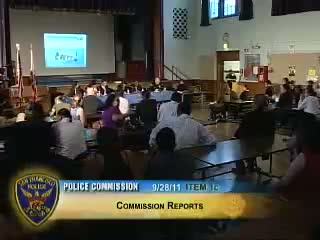
The San Francisco Police Commission voted 5–0 on Sept. 28 to adopt Department General Order 1.08, a department-wide community policing policy, and to rescind General Order 3.11.
The vote followed a presentation from Chief Gregory Sir and a lengthy public comment period in which neighborhood leaders, nonprofit directors and youth representatives urged adoption while pressing for clear implementation metrics. Commissioner Angela Chan moved to adopt the order; Commissioner Petra de Jesus seconded. The clerk recorded five aye votes and the motion passed unanimously.
Why it matters: Commissioners and community members described the action as a formal step to make community policing standard across the San Francisco Police Department, not just a local initiative. Supervisor David Campos, who helped draft related legislation, told the commission the goal is sustained collaboration between residents, nonprofits and police so that "community policing is something tangible" rather than only rhetorical.
What the order does and what's missing: Chief Sir asked the commission to adopt DGO 1.08 as the governing policy and said the new order consolidates community input from multiple neighborhoods. He said the new order will be posted on the city website once staff complete the upload. Multiple commenters praised local programs — including HOMEY, the Central American Resource Center, the Mission Boys & Girls Club and the Community Response Network — and urged the commission to assign staff and timelines to implementation tasks such as officer and community training and creation of a publicly available community-resources manual.
Commissioner Angela Chan, who moved the adoption, reflected community impatience with policy that is not followed by action: "I've seen department general orders not fully implemented," she said, and asked for concrete plans and a six-month check-in. Chief Sir and Joyce Hicks, director of the Office of Citizen Complaints, both told commissioners that implementation and compliance would be overseen from department leadership and OCC involvement.
Community concerns and responses: Several speakers welcomed the policy but asked how implementation would be measured. Nila Farkansari, an immigration attorney, raised concerns about undocumented residents' willingness to report crimes under programs such as Secure Communities. Commissioner Chan acknowledged the fear and said San Francisco has been a leader in pushing back against federal programs that can discourage reporting.
Operational context: Captain Carlos Corrales described Mission Station staffing, a renewed emphasis on foot-beat policing and crime trends through Sept. 24, 2011. He told the commission that, while property crimes had ticked up, violent crimes were down about 6 percent year to date, and he credited temporary saturation patrols and partnerships for recent decreases in robberies and aggravated assaults. Capitan Corrales also read a press release announcing the arrest of a 15-year-old juvenile in an August homicide investigation and said the arrest followed a month-long investigation with community cooperation.
Next steps: Commissioners asked that the department return with implementation updates; one commissioner suggested a December update focused on the community-resources manual, training rollout and the public website. Chief Sir said he would work to post the general order on the SFGov website as quickly as possible.
The commission adopted DGO 1.08 and replaced DGO 3.11; the commission recorded a 5–0 vote in favor. The commission set expectations for follow-up reporting on implementation and community oversight.