Get Full Government Meeting Transcripts, Videos, & Alerts Forever!
Get email alerts on the Police Operations topic
No spam. Unsubscribe anytime.
SFPD chief’s 100‑day review cites small crime declines and new reforms as residents press profiling, DNA concerns
Summary
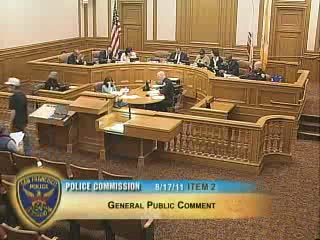
At an Aug. 17 Police Commission meeting, the chief presented a 100‑day review reporting modest declines in Part 1 crime and a slate of reforms — community policing DGO, a task‑force response and plainclothes training with a body‑camera pilot — while several public speakers alleged racial profiling and the improper collection of DNA swabs.
The San Francisco Police Commission on Aug. 17 heard a 100‑day report from the chief (referred to in the transcript as “Chief Sir”) who said the department has prioritized reducing violent crime, expanding community policing policy and improving data access for officers. The chief credited reorganizations and targeted task‑force responses for modest drops in Part 1 crimes: he reported a roughly 4 percent reduction in violent crime and a 3 percent dip in property crime in the recent comparison period and said the Bayview district had seized roughly 80 guns year‑to‑date, contributing to local declines.
The chief described several operational changes underway: a draft community policing departmental general order (DGO) and best practices manual, a formalized “task‑force response” intended to front‑load investigative information into a department operations center within 24 hours of serious incidents, expanded plainclothes training with minimum hours and a pilot program to test personal cameras for sergeants conducting entries and “knock and talks.” He also listed expanded community outreach (more than 35 meetings), a newly consolidated Special Victims Unit, a crime data warehouse to make incident reports searchable citywide and efforts to make mugshots available to officers in stations and, later, in vehicles.
Commissioners praised the report and asked the chief to formalize task‑force procedures in writing, to preserve academy classes to maintain staffing gains and to provide a written 6‑ to 12‑month implementation plan. The chief said staffing and technology were the two main long‑term challenges and urged continued budget support to maintain gains.
Public commenters raised sharply contrasting concerns. John Crewe of the ACLU disputed earlier staff statements about the Portland resolution related to police participation in the Joint Terrorism Task Force, providing what he said was the Portland resolution and urging San Francisco to apply its own rules to JTTF activity. Laveena Duvall of the Asian Law Caucus said advocates had been pursuing federal cooperation and were preparing to raise the Portland resolution with the Board of Supervisors.
Several other members of the public gave testimony alleging local misconduct. Ace Washington and a young man who identified himself as Shadon Mitchell described an arrest and later collection of a DNA swab; Mitchell said he was not read Miranda warnings, held overnight and later approached by plainclothes officers who took a mouth swab and then released him. DeBray Carpenter described an arrest he characterized as retaliatory after a television interview and alleged continued harassment and towing of family vehicles. At least one commissioner cautioned that the events sounded like open investigations and advised witnesses with counsel to be careful about public testimony.
The commission took routine actions: it voted to receive and file the OCC second‑quarter DGO status report on the consent calendar and later voted to move an identified disciplinary agenda item into closed session. The chief said he would follow up on the Portland/Portland‑resolution questions and requested Captain Murphy appear to clarify communications with Portland at a subsequent meeting.
The commission closed with scheduling and procedural announcements; the chief and staff agreed to provide written follow‑ups on the community policing DGO, plainclothes training standards and the Portland/JTTF issue.
The chief and multiple commissioners emphasized that many initiatives — from community policing guidance to youth engagement and technology upgrades — remain in development and will return to the commission for further review and public input.