Get Full Government Meeting Transcripts, Videos, & Alerts Forever!
Get email alerts on the Oversight Complaints topic
No spam. Unsubscribe anytime.
San Francisco OCC reports drop in complaints in 2010, outlines investigation and mediation process
Summary
The Office of Citizen Complaints told the Police Commission it received 854 complaints in 2010 (down 16% from 2009), has 33 staff, and runs a mediation program it says resolves many cases; the OCC described its investigative steps and a high agreement rate with the police chief.
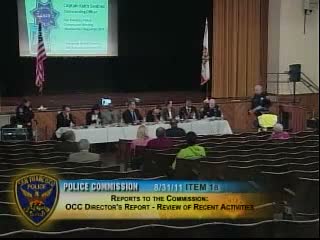
Joyce Hicks, executive director of the Office of Citizen Complaints, told the San Francisco Police Commission on Aug. 31 that the OCC received 854 complaints in 2010, a 16 percent drop from 2009’s 1,018, and that the office currently has 33 staff members, most of them investigators.
Hicks described the OCC’s role as a civilian oversight agency that investigates complaints of police misconduct, makes policy recommendations and offers mediation as an alternative to discipline. "When we conduct an investigation, we do so to find out what happened. We follow the evidence," Hicks said, describing interviews with complainants and witnesses, documentary requests to the police department and multiple supervisory reviews before the OCC reaches a finding.
The OCC reported it mediated 63 complaints last year — about 8 percent of the 812 cases it closed — and that mediations are voluntary for both complainants and officers. Hicks told commissioners the OCC forwards sustained findings to the police chief, who may impose discipline up to a 10-day suspension; cases requiring greater discipline are within the commission’s jurisdiction. She said the OCC can independently file charges with the police commission in more serious cases and that agreement between the OCC and the chief is high.
Commissioner Jamie Slaughter asked whether the downward trend continued; Hicks said that as of the end of August 2011, complaints in 2011 were about 10 percent fewer than they had been through Aug. 31, 2010.
The OCC also provided demographic and outcome breakdowns: sustained findings were about 9 percent of closed cases, and allegations of unnecessary force represented roughly 10 percent of allegations, according to the director’s report. Hicks closed by emphasizing the OCC’s goal to increase public trust through timely, fair and unbiased investigations.
The commission did not take any formal action on the OCC’s report; the presentation was an informational briefing and a chance for commissioners and the public to ask questions.